7. write an equation for the $n$th term of the given geometric sequence: 2, 6, 18, ...\na…
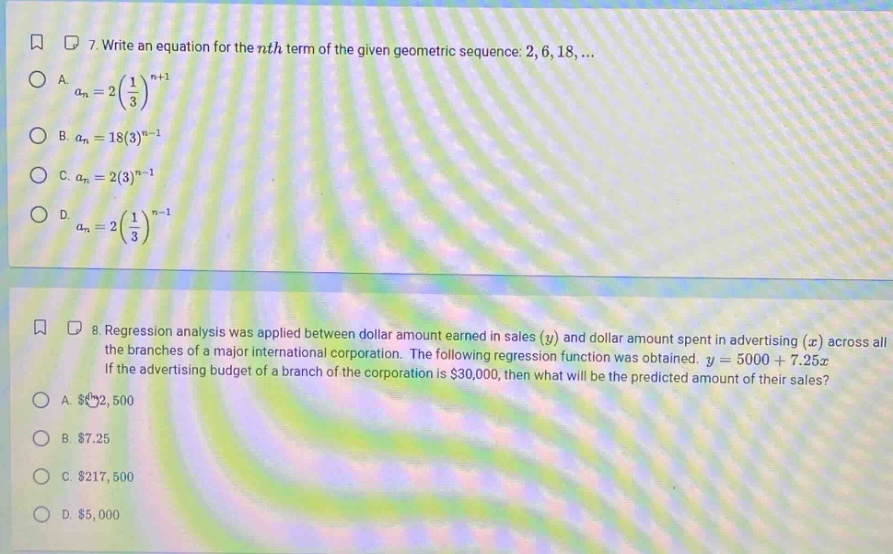
7. write an equation for the $n$th term of the given geometric sequence: 2, 6, 18, ...\na. $a_{n}=2(\\frac{1}{3})^{n + 1}$\nb. $a_{n}=18(3)^{n - 1}$\nc. $a_{n}=2(3)^{n - 1}$\nd. $a_{n}=2(\\frac{1}{3})^{n - 1}$\n8. regression analysis was applied between dollar amount earned in sales ($y$) and dollar amount spent in advertising ($x$) across all the branches of a major international corporation. the following regression function was obtained. $y = 5000+7.25x$. if the advertising budget of a branch of the corporation is $30,000, then what will be the predicted amount of their sales?\na. $82,500\nb. $7.25\nc. $217,500\nd. $5,000
Answer
7.
Explanation:
Step1: Identify first - term and common ratio
The first - term (a_1) of the geometric sequence (2,6,18,\cdots) is (a_1 = 2). The common ratio (r=\frac{a_{n + 1}}{a_n}), so (r=\frac{6}{2}=3).
Step2: Recall the formula for the (n)th term of a geometric sequence
The formula for the (n)th term of a geometric sequence is (a_n=a_1r^{n - 1}).
Step3: Substitute values into the formula
Substitute (a_1 = 2) and (r = 3) into the formula (a_n=a_1r^{n - 1}), we get (a_n=2\times(3)^{n - 1}).
Answer:
C. (a_n = 2(3)^{n - 1})
8.
Explanation:
Step1: Identify the regression function and given value
The regression function is (y = 5000+7.25x), and the advertising budget (x = 30000).
Step2: Substitute (x) into the regression function
Substitute (x = 30000) into (y = 5000+7.25x), we have (y=5000+7.25\times30000).
Step3: Calculate the value of (y)
First, calculate (7.25\times30000 = 217500), then (y=5000 + 217500=222500).
Answer:
A. ($222,500)