write two expressions for the perimeter of the figure. note: the figure is not drawn to scale. (a) use all…
write two expressions for the perimeter of the figure. note: the figure is not drawn to scale. (a) use all four side lengths. perimeter = + + + (b) simplify the expression from part (a). perimeter =
Answer
Explanation:
Step1: Write expression using all side - lengths
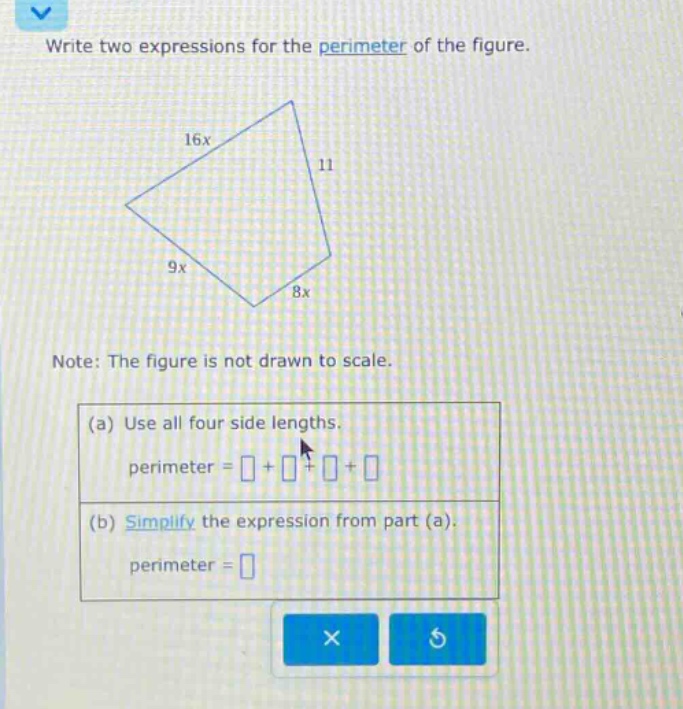
The perimeter of a polygon is the sum of the lengths of its sides. The side - lengths of the given polygon are (16x), (11), (8x), and (9x). So the first expression for the perimeter using all four side - lengths is (16x + 11+8x + 9x).
Step2: Simplify the expression
Combine like terms. The terms with the variable (x) are (16x), (8x), and (9x). (16x+8x + 9x=(16 + 8+9)x=33x). So the simplified expression for the perimeter is (33x + 11).
Answer:
(a) perimeter (=16x+11 + 8x+9x) (b) perimeter (=33x + 11)