xon math 6/5—homeschool 25. if the radius of this circle is 12 millimeters, then what is the diameter of the…
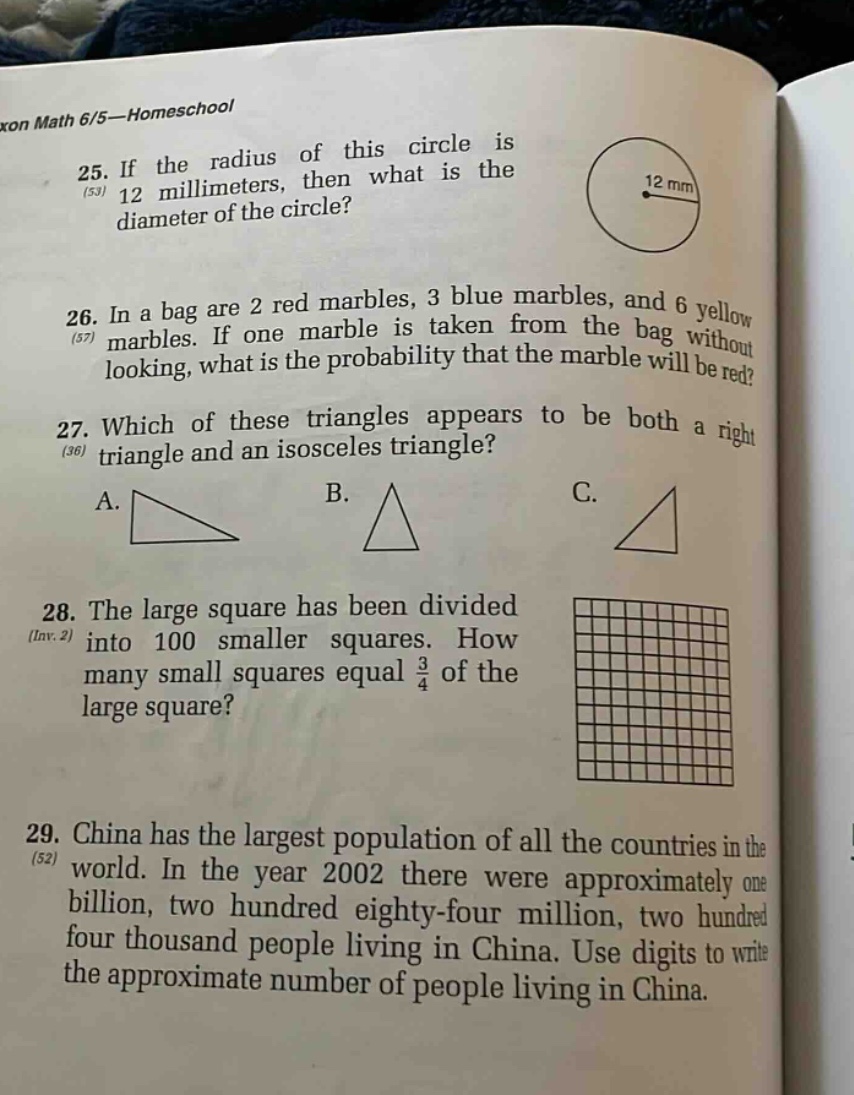
xon math 6/5—homeschool 25. if the radius of this circle is 12 millimeters, then what is the diameter of the circle? 26. in a bag are 2 red marbles, 3 blue marbles, and 6 yellow marbles. if one marble is taken from the bag without looking, what is the probability that the marble will be red? 27. which of these triangles appears to be both a right triangle and an isosceles triangle? a. b. c. 28. the large square has been divided into 100 smaller squares. how many small squares equal 3/4 of the large square? 29. china has the largest population of all the countries in the world. in the year 2002 there were approximately one billion, two hundred eighty - four million, two hundred four thousand people living in china. use digits to write the approximate number of people living in china.
Answer
25.
Explanation:
Step1: Recall diameter - radius relation
The diameter $d$ of a circle is twice the radius $r$, i.e., $d = 2r$.
Step2: Substitute the given radius
Given $r=12$ mm, then $d = 2\times12$ mm. $d = 24$ mm
Answer:
24 mm
26.
Explanation:
Step1: Calculate total number of marbles
The total number of marbles $n$ is the sum of red, blue and yellow marbles. So $n=2 + 3+6=11$ marbles.
Step2: Calculate probability of red marbles
The probability $P$ of picking a red marble is the number of red marbles divided by the total number of marbles. There are 2 red marbles, so $P=\frac{2}{11}$.
Answer:
$\frac{2}{11}$
27.
Brief Explanations:
A right - isosceles triangle has one right angle (90 degrees) and two equal sides. Option C has a right angle and two equal - length sides.
Answer:
C.
28.
Explanation:
Step1: Understand the problem
We know the large square is divided into 100 smaller squares and we need to find $\frac{3}{4}$ of 100.
Step2: Calculate the number of small squares
We use the formula for finding a fraction of a number: $\frac{3}{4}\times100=\frac{3\times100}{4}=75$.
Answer:
75
29.
Explanation:
Step1: Write each part in digits
One billion is 1000000000, two hundred eighty - four million is 284000000, two hundred four thousand is 204000.
Step2: Add them together
$1000000000+284000000 + 204000=1284204000$
Answer:
1284204000