the yearly cost in dollars, y, at a video game arcade based on total game tokens purchased, x, is y =…
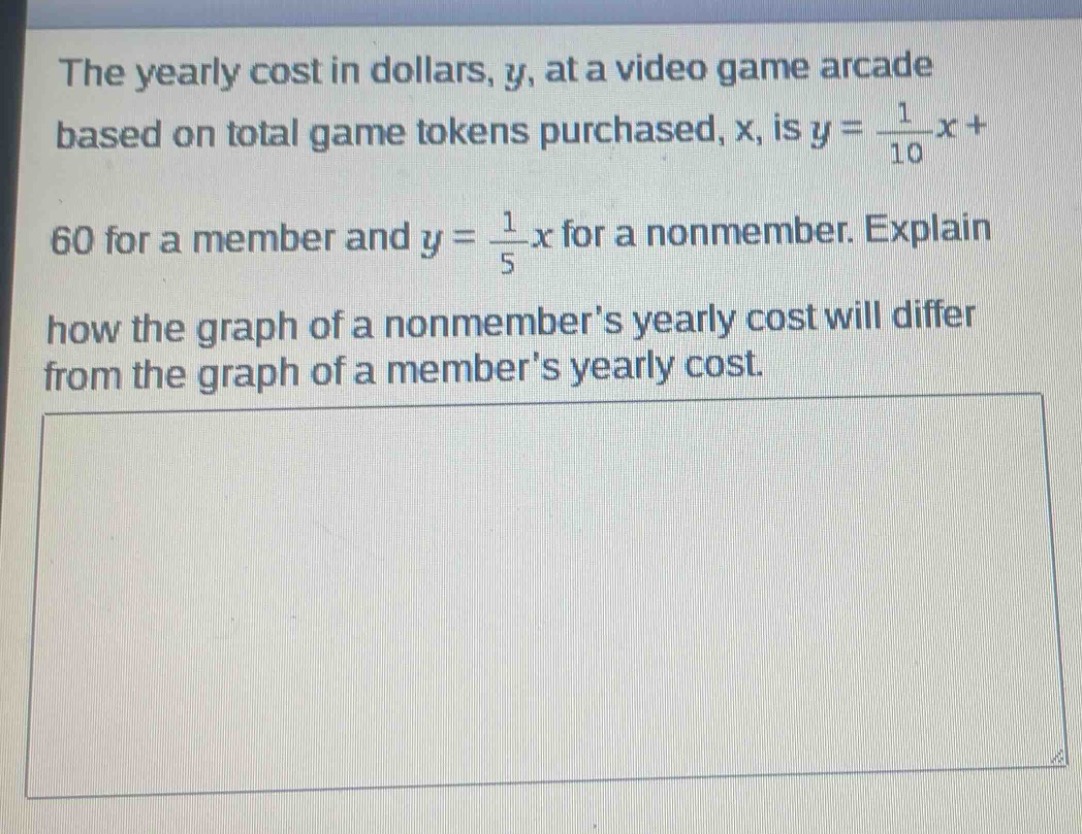
the yearly cost in dollars, y, at a video game arcade based on total game tokens purchased, x, is y = \\frac{1}{10}x + 60 for a member and y = \\frac{1}{5}x for a non - member. explain how the graph of a non - members yearly cost will differ from the graph of a members yearly cost.
Answer
Answer:
The graph of the non - member's cost ($y=\frac{1}{5}x$) has a steeper slope and passes through the origin, while the graph of the member's cost ($y = \frac{1}{10}x+60$) has a less steep slope and a $y$-intercept of 60.
Explanation:
Step1: Identify slope and y - intercept of member's cost
The member's cost equation is $y=\frac{1}{10}x + 60$. The slope $m_1=\frac{1}{10}$ and the $y$-intercept $b_1 = 60$.
Step2: Identify slope and y - intercept of non - member's cost
The non - member's cost equation is $y=\frac{1}{5}x$. The slope $m_2=\frac{1}{5}$ and the $y$-intercept $b_2 = 0$.
Step3: Compare slopes
Since $\frac{1}{5}>\frac{1}{10}$, the non - member's cost graph has a steeper slope.
Step4: Compare y - intercepts
The non - member's cost graph passes through the origin $(0,0)$ as $b_2 = 0$, while the member's cost graph crosses the $y$-axis at $(0,60)$ as $b_1=60$.