you pick one card from each set, spin the spinner, and find the sum. how many different sums are possible?
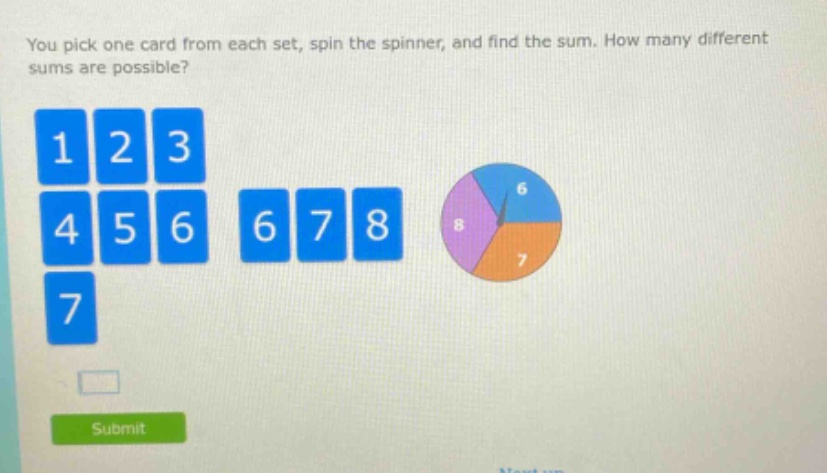
you pick one card from each set, spin the spinner, and find the sum. how many different sums are possible?
Answer
Explanation:
Step1: Calculate total number of combinations
There are 7 cards in the first - set, 3 cards in the second - set, and 3 sections on the spinner. The total number of combinations of picking cards and spinning the spinner is $7\times3\times3=63$.
Step2: Consider the minimum and maximum sums
The minimum sum occurs when we pick the smallest card from each set and spin the smallest number on the spinner. The smallest card from the first set is 1, from the second set is 6, and on the spinner is 6. So the minimum sum is $1 + 6+6 = 13$. The maximum sum occurs when we pick the largest card from each set and spin the largest number on the spinner. The largest card from the first set is 7, from the second set is 8, and on the spinner is 8. So the maximum sum is $7 + 8+8 = 23$.
Step3: Analyze possible sums
We can list out all possible sums. Let the numbers on the first - set of cards be $a\in{1,2,3,4,5,6,7}$, on the second - set be $b\in{6,7,8}$, and on the spinner be $c\in{6,7,8}$. The sum $S=a + b + c$. We can brute - force all 63 combinations: When $a = 1,b = 6,c = 6$, $S=13$; when $a = 1,b = 6,c = 7$, $S = 14$; when $a = 1,b = 6,c = 8$, $S = 15$; when $a = 1,b = 7,c = 6$, $S = 14$ (already counted in a previous case); when $a = 1,b = 7,c = 7$, $S = 15$ (already counted); when $a = 1,b = 7,c = 8$, $S = 16$; when $a = 1,b = 8,c = 6$, $S = 15$ (already counted); when $a = 1,b = 8,c = 7$, $S = 16$ (already counted); when $a = 1,b = 8,c = 8$, $S = 17$; and so on. By listing out all possible sums and removing duplicates, we find that the possible sums range from 13 to 23. We can also think about it in terms of the increments. The smallest value of $a + b + c$ is $1+6 + 6=13$ and the largest is $7+8 + 8=23$. Since we are adding integers, and we can change the values of $a,b,c$ in small integer - valued steps, we can check for non - existence of gaps in the possible sums in the range $[13,23]$. The number of integers in the range from 13 to 23 (inclusive) is $23−13 + 1=11$.
Answer:
11