how can you use transformations to graph this function?\n$y = 3cdot7^{-x}+2$\nexplain your steps.
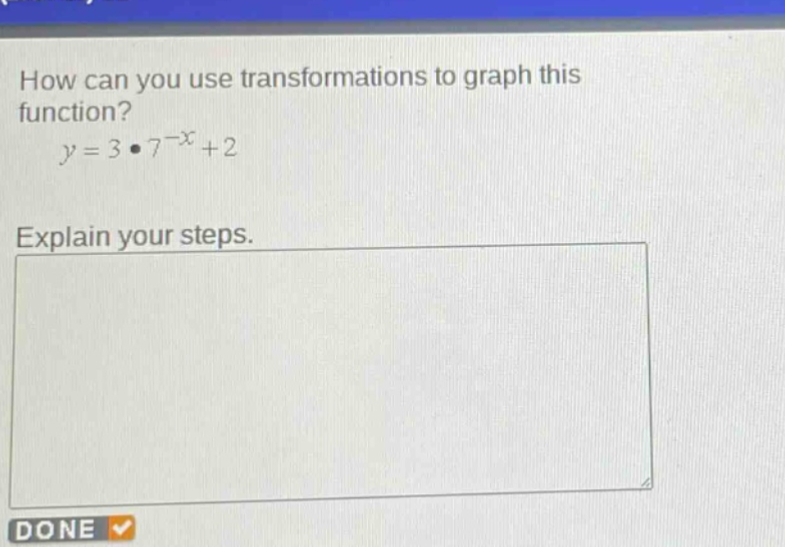
how can you use transformations to graph this function?\n$y = 3cdot7^{-x}+2$\nexplain your steps.
Answer
Answer:
- Start with the parent - function (y = a^x), here the parent - function is (y = 7^x).
- Reflect the graph of (y = 7^x) across the (y) - axis to get the graph of (y = 7^{-x}) because replacing (x) with (-x) in a function (y = f(x)) reflects its graph across the (y) - axis.
- Vertically stretch the graph of (y = 7^{-x}) by a factor of 3 to get the graph of (y = 3\cdot7^{-x}) since multiplying the function (y = f(x)) by a positive constant (a>1) (here (a = 3)) vertically stretches its graph.
- Shift the graph of (y = 3\cdot7^{-x}) up 2 units to get the graph of (y = 3\cdot7^{-x}+2) because adding a positive constant (k) (here (k = 2)) to a function (y = f(x)) shifts its graph up by (k) units.
Explanation:
Step1: Identify parent - function
The parent - function of (y = 3\cdot7^{-x}+2) is (y = 7^x).
Step2: Apply (x) - axis reflection
Replace (x) with (-x) in (y = 7^x) to get (y = 7^{-x}).
Step3: Apply vertical stretch
Multiply (y = 7^{-x}) by 3 to get (y = 3\cdot7^{-x}).
Step4: Apply vertical shift
Add 2 to (y = 3\cdot7^{-x}) to get (y = 3\cdot7^{-x}+2).