what are the zeros of the quadratic function f(x) = 2x² + 16x - 9?\no x=-4 - √(7/2) and x=-4 + √(7/2)\no…
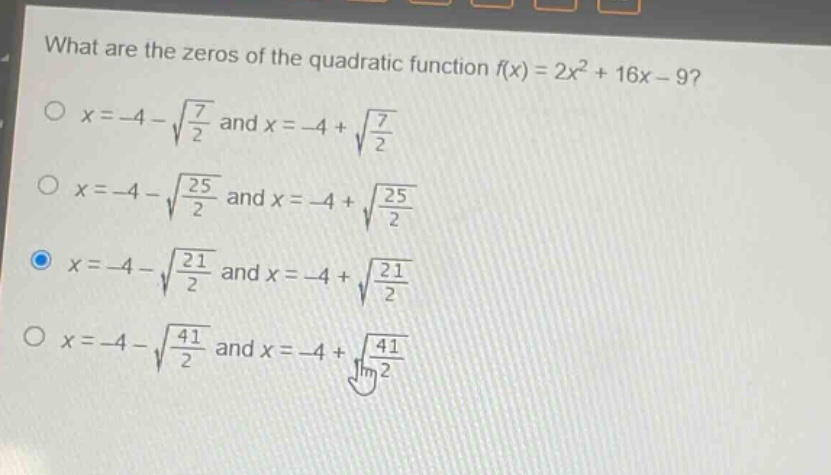
what are the zeros of the quadratic function f(x) = 2x² + 16x - 9?\no x=-4 - √(7/2) and x=-4 + √(7/2)\no x=-4 - √(25/2) and x=-4 + √(25/2)\no x=-4 - √(21/2) and x=-4 + √(21/2)\no x=-4 - √(41/2) and x=-4 + √(41/2)
Answer
Explanation:
Step1: Recall quadratic - formula
For a quadratic function (ax^{2}+bx + c = 0), the solutions are given by (x=\frac{-b\pm\sqrt{b^{2}-4ac}}{2a}). For (f(x)=2x^{2}+16x - 9), we have (a = 2), (b = 16), and (c=-9).
Step2: Calculate the discriminant (\Delta=b^{2}-4ac)
Substitute (a = 2), (b = 16), (c=-9) into (\Delta). (\Delta=(16)^{2}-4\times2\times(-9)=256 + 72=328).
Step3: Apply the quadratic - formula
(x=\frac{-16\pm\sqrt{328}}{2\times2}=\frac{-16\pm2\sqrt{82}}{4}=\frac{-8\pm\sqrt{82}}{2}). Another way is: [ \begin{align*} x&=\frac{-16\pm\sqrt{16^{2}-4\times2\times(-9)}}{2\times2}\ &=\frac{-16\pm\sqrt{256 + 72}}{4}\ &=\frac{-16\pm\sqrt{328}}{4}\ &=\frac{-16\pm2\sqrt{82}}{4}\ &=- 4\pm\frac{\sqrt{82}}{2}=-4\pm\sqrt{\frac{41}{2}\times2}\div\sqrt{2}=-4\pm\sqrt{\frac{41}{2}} \end{align*} ]
Answer:
D. (x=-4-\sqrt{\frac{41}{2}}) and (x=-4 + \sqrt{\frac{41}{2}})