14. if $p(a)=0.5$ and $p(b)=0.4$, and $a$ and $b$ are independent, what is $p(acap b)$?\n a. 0.2\n b. 0.7\n…
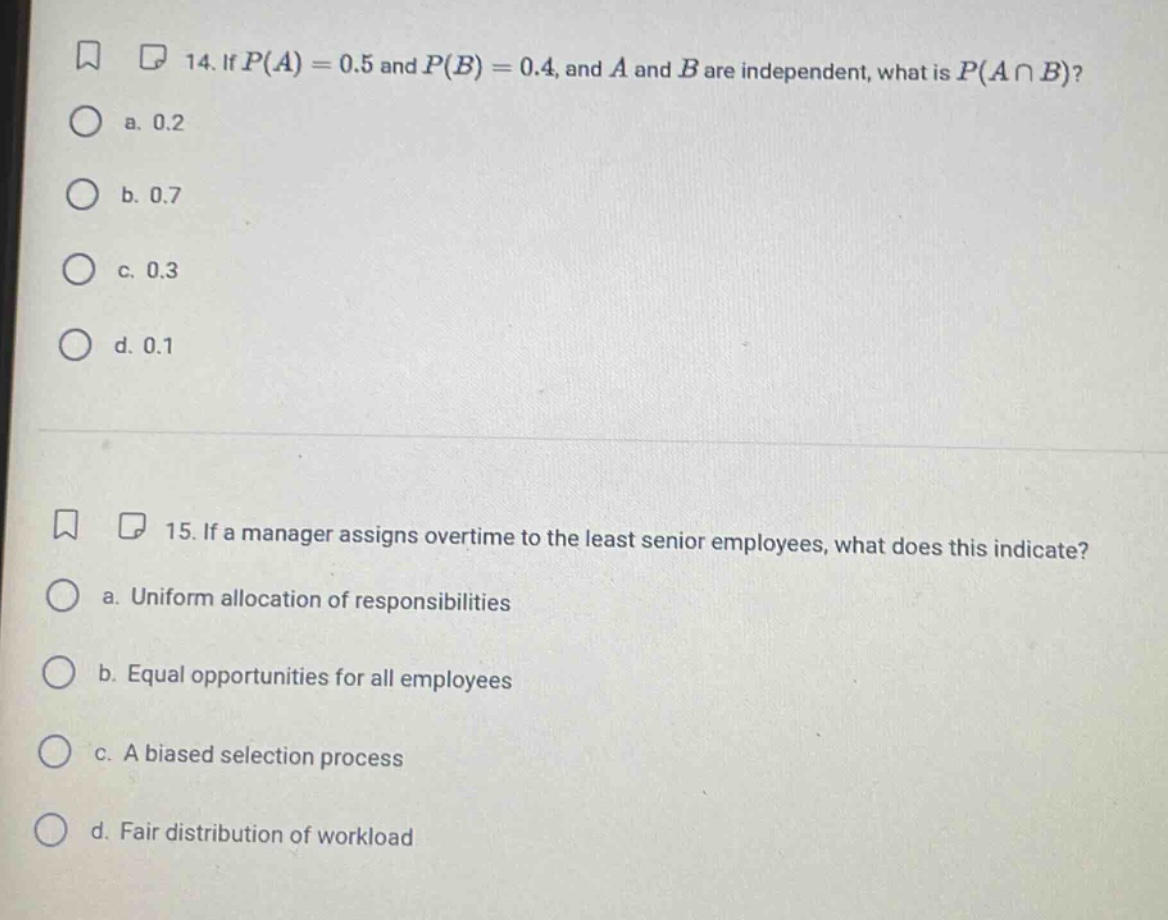
14. if $p(a)=0.5$ and $p(b)=0.4$, and $a$ and $b$ are independent, what is $p(acap b)$?\n a. 0.2\n b. 0.7\n c. 0.3\n d. 0.1\n15. if a manager assigns overtime to the least senior employees, what does this indicate?\n a. uniform allocation of responsibilities\n b. equal opportunities for all employees\n c. a biased selection process\n d. fair distribution of workload
Answer
Answer:
- A. 0.2
- C. A biased selection process
Explanation:
Step1: Recall probability formula for independent events
For independent events (A) and (B), (P(A\cap B)=P(A)\times P(B))
Step2: Substitute given values
Given (P(A) = 0.5) and (P(B)=0.4), then (P(A\cap B)=0.5\times0.4 = 0.2)
For question 15: Assigning overtime only to the least - senior employees is not an equal or fair distribution as it does not consider all employees equally. It is a biased selection process as it favors a particular group (non - senior employees) over others.