in the 1980s, many musicians and journalists in the english - speaking world began to draw attention to…
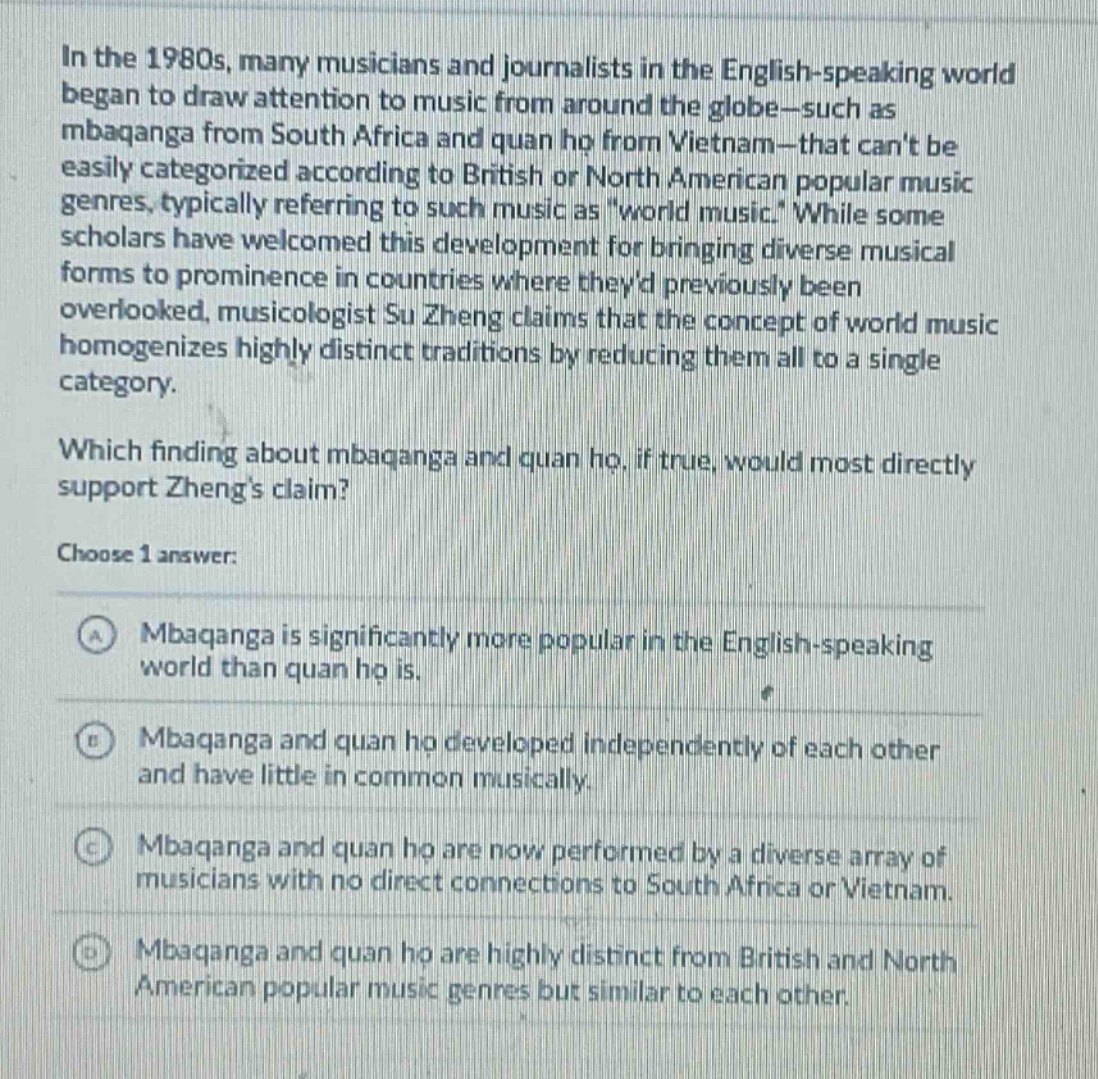
in the 1980s, many musicians and journalists in the english - speaking world began to draw attention to music from around the globe - such as mbaqanga from south africa and quan ho from vietnam - that cant be easily categorized according to british or north american popular music genres, typically referring to such music as world music. while some scholars have welcomed this development for bringing diverse musical forms to prominence in countries where theyd previously been overlooked, musicologist su zheng claims that the concept of world music homogenizes highly distinct traditions by reducing them all to a single category. which finding about mbaqanga and quan ho, if true, would most directly support zhengs claim? choose 1 answer: a mbaqanga is significantly more popular in the english - speaking world than quan ho is. b mbaqanga and quan ho developed independently of each other and have little in common musically. c mbaqanga and quan ho are now performed by a diverse array of musicians with no direct connections to south africa or vietnam. d mbaqanga and quan ho are highly distinct from british and north american popular music genres but similar to each other.
Answer
Brief Explanations:
Zheng claims that the concept of world - music homogenizes distinct traditions by lumping them together. If mbaqanga and quan ho developed independently and have little in common musically (Option B), then grouping them under the single category of world - music would indeed be an act of homogenization, as it ignores their unique musical identities. Option A is about popularity differences, not about homogenization. Option C is about the performers and not about the homogenization of the musical traditions. Option D says they are similar to each other, which goes against the idea of distinct traditions being homogenized.
Answer:
B. Mbaqanga and quan ho developed independently of each other and have little in common musically.