21 car engines operate by burning gasoline to release stored energy. in most engines, only one - third of…
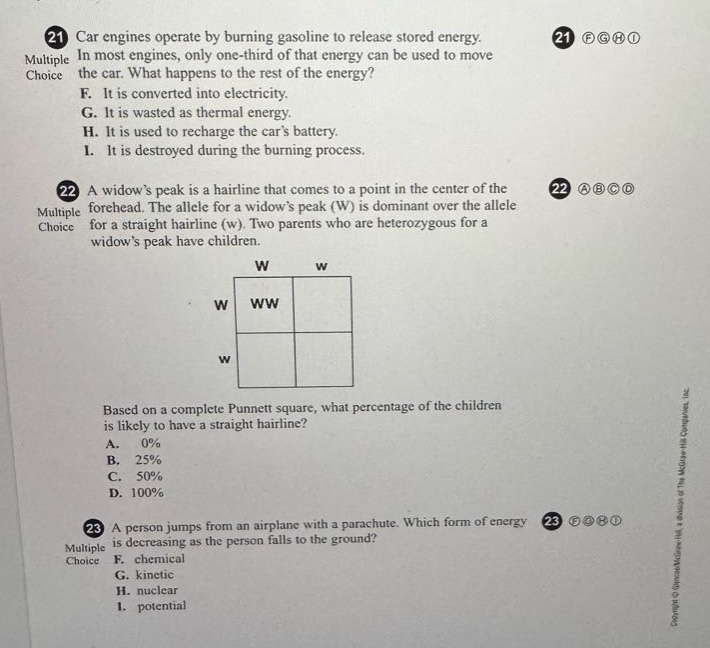
21 car engines operate by burning gasoline to release stored energy. in most engines, only one - third of that energy can be used to move the car. what happens to the rest of the energy? f. it is converted into electricity. g. it is wasted as thermal energy. h. it is used to recharge the cars battery. i. it is destroyed during the burning process. 22 a widows peak is a hairline that comes to a point in the center of the forehead. the allele for a widows peak (w) is dominant over the allele for a straight hairline (w). two parents who are heterozygous for a widows peak have children. based on a complete punnett square, what percentage of the children is likely to have a straight hairline? a. 0% b. 25% c. 50% d. 100% 23 a person jumps from an airplane with a parachute. which form of energy is decreasing as the person falls to the ground? f. chemical g. kinetic h. nuclear i. potential
Answer
Question 21
Explanation:
Step1: Recall energy - conversion in car engines
In car engines, during gasoline - burning, energy is released. According to the law of conservation of energy, energy is not created or destroyed but transformed. Most of the energy that is not used for moving the car is dissipated as heat.
Answer:
G. It is wasted as thermal energy.
Question 22
Explanation:
Step1: Complete the Punnett square
The parents are heterozygous (Ww). The Punnett - square cross gives the genotypes WW:Ww:Ww:ww in a 1:2:1 ratio.
Step2: Determine the phenotype ratio
Since ww represents the straight - hairline (recessive trait), and there is 1 ww out of 4 possible genotypes, the probability is $\frac{1}{4}=25%$.
Answer:
B. 25%
Question 23
Explanation:
Step1: Recall the types of energy
Potential energy is given by $PE = mgh$ (where $m$ is mass, $g$ is the acceleration due to gravity, and $h$ is height). As a person falls from an airplane, the height $h$ decreases. Since $m$ and $g$ are constant, the potential energy decreases.
Answer:
I. potential