22. in painting or drawing, __________ lines are the edge of an object.\n23. an __________ line is a…
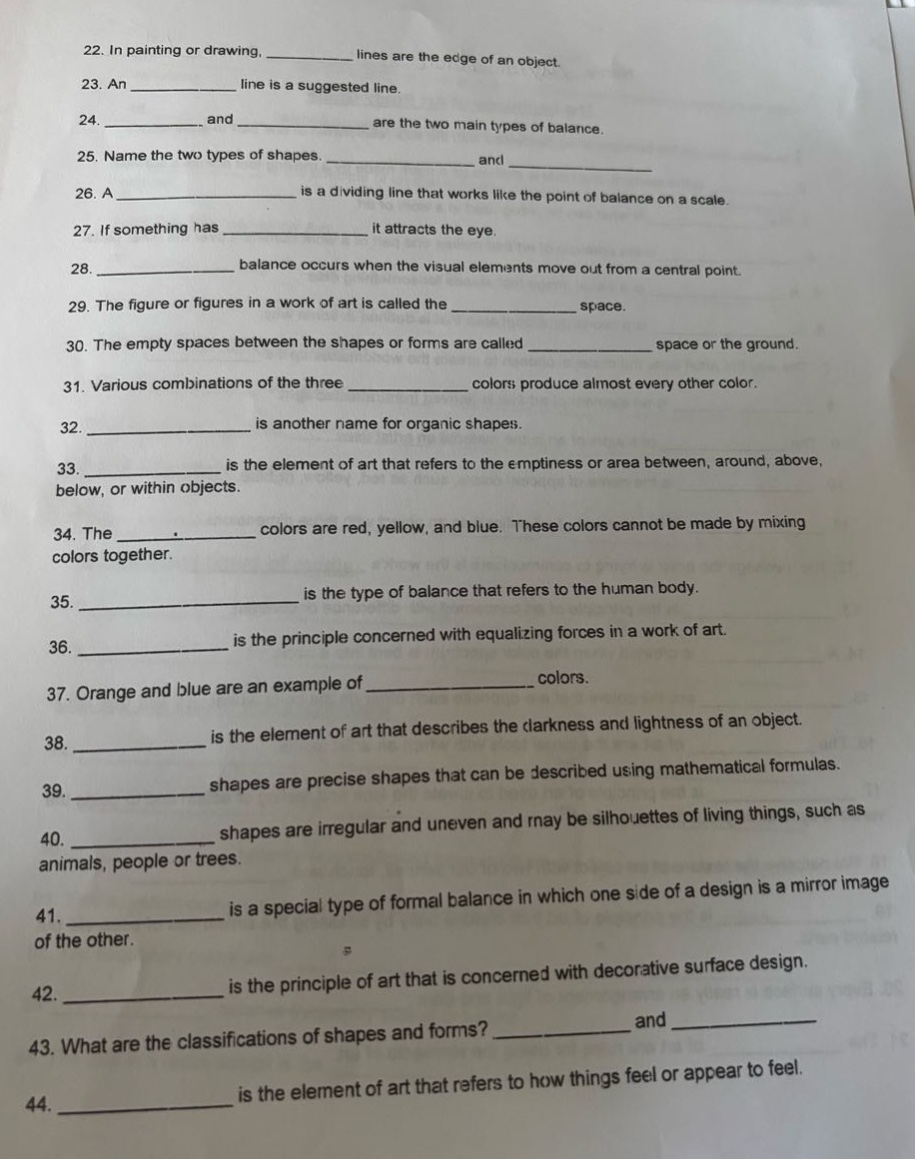
22. in painting or drawing, __________ lines are the edge of an object.\n23. an __________ line is a suggested line.\n24. __________ and __________ are the two main types of balance.\n25. name the two types of shapes. __________ and __________\n26. a __________ is a dividing line that works like the point of balance on a scale.\n27. if something has __________ it attracts the eye.\n28. __________ balance occurs when the visual elements move out from a central point.\n29. the figure or figures in a work of art is called the __________ space.\n30. the empty spaces between the shapes or forms are called __________ space or the ground.\n31. various combinations of the three __________ colors produce almost every other color.\n32. __________ is another name for organic shapes.\n33. __________ is the element of art that refers to the emptiness or area between, around, above, below, or within objects.\n34. the __________ colors are red, yellow, and blue. these colors cannot be made by mixing colors together.\n35. __________ is the type of balance that refers to the human body.\n36. __________ is the principle concerned with equalizing forces in a work of art.\n37. orange and blue are an example of __________ colors.\n38. __________ is the element of art that describes the darkness and lightness of an object.\n39. __________ shapes are precise shapes that can be described using mathematical formulas.\n40. __________ shapes are irregular and uneven and may be silhouettes of living things, such as animals, people or trees.\n41. __________ is a special type of formal balance in which one side of a design is a mirror image of the other.\n42. __________ is the principle of art that is concerned with decorative surface design.\n43. what are the classifications of shapes and forms? __________ and __________\n44. __________ is the element of art that refers to how things feel or appear to feel.
Answer
Brief Explanations:
- In art, contour lines define the edge of an object.
- An implied line is a suggested line, not physically drawn but perceived.
- Symmetrical and asymmetrical are the two main types of balance in art.
- Geometric and organic are the two types of shapes.
- A fulcrum - like line in art is a dividing line for balance.
- Visual interest makes something attract the eye.
- Radial balance has elements moving out from a central point.
- The figure in art is the positive space.
- The empty spaces are negative space.
- Primary colors can create other colors through combinations.
- Free - form is another name for organic shapes.
- Space in art refers to the emptiness around objects.
- Red, yellow, and blue are primary colors.
- Bilateral symmetry is related to the human - body balance.
- Balance is about equalizing forces in art.
- Orange and blue are complementary colors.
- Value describes lightness and darkness in art.
- Geometric shapes can be described with math.
- Organic shapes are irregular.
- Symmetry is a special formal balance with mirror - image sides.
- Pattern is about decorative surface design in art.
- Shapes and forms are classified as two - dimensional (shapes) and three - dimensional (forms).
- Texture in art is about how things feel or appear to feel.
Answer:
- Contour
- Implied
- Symmetrical, Asymmetrical
- Geometric, Organic
- Fulcrum - like
- Visual interest
- Radial
- Positive
- Negative
- Primary
- Free - form
- Space
- Primary
- Bilateral symmetry
- Balance
- Complementary
- Value
- Geometric
- Organic
- Symmetry
- Pattern
- Two - dimensional, Three - dimensional
- Texture