71. gabriel is testing the properties of four brands of golf - balls. he places them in graduated cylinders…
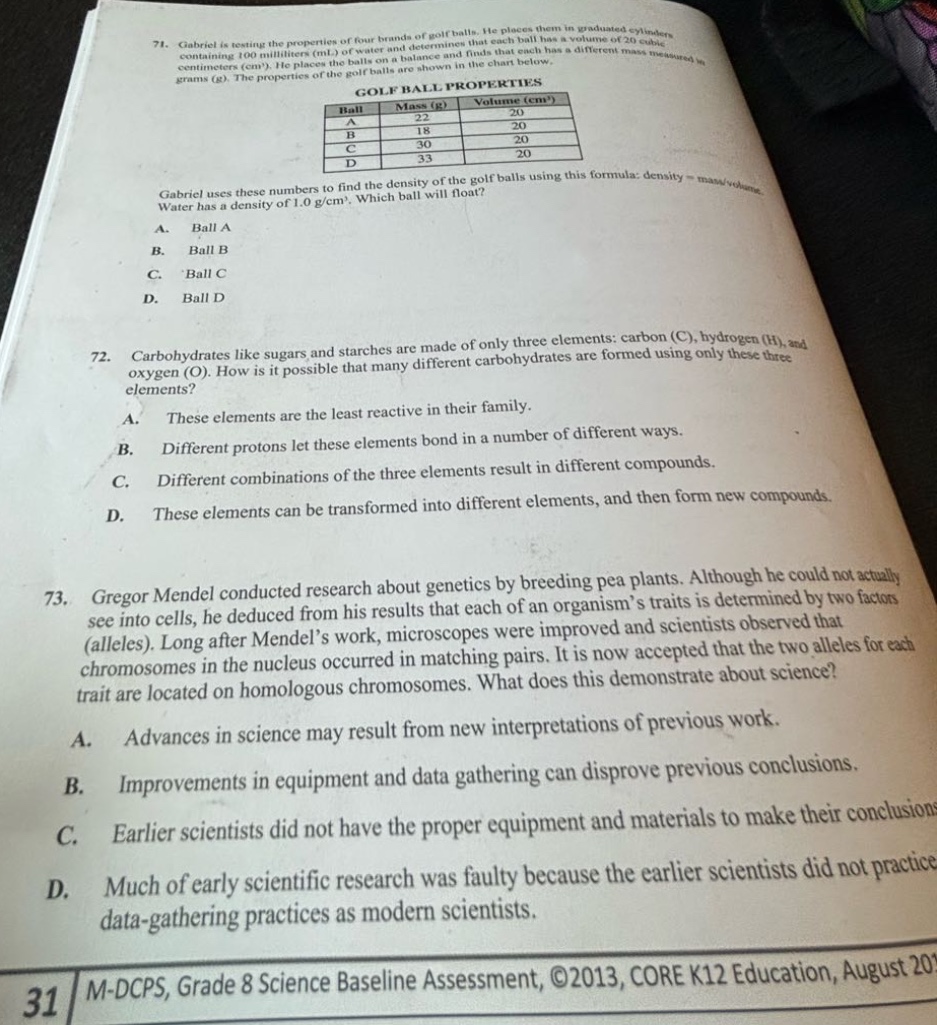
71. gabriel is testing the properties of four brands of golf - balls. he places them in graduated cylinders containing 50 milliliters (ml) of water and determines that each ball has a volume of 20 cubic centimeters (cm³). he places the balls on a balance and finds that each has a different mass measured in grams (g). the properties of the golf - balls are shown in the chart below. golf ball properties ball mass (g) volume (cm³) a 22 20 b 18 20 c 30 20 d 33 20 gabriel uses these numbers to find the density of the golf - balls using this formula: density = mass/volume. water has a density of 1.0 g/cm³. which ball will float? a. ball a b. ball b c. ball c d. ball d 72. carbohydrates like sugars and starches are made of only three elements: carbon (c), hydrogen (h), and oxygen (o). how is it possible that many different carbohydrates are formed using only these three elements? a. these elements are the least reactive in their family. b. different protons let these elements bond in a number of different ways. c. different combinations of the three elements result in different compounds. d. these elements can be transformed into different elements, and then form new compounds. 73. gregor mendel conducted research about genetics by breeding pea plants. although he could not actually see into cells, he deduced from his results that each of an organisms traits is determined by two factors (alleles). long after mendels work, microscopes were improved and scientists observed that chromosomes in the nucleus occurred in matching pairs. it is now accepted that the two alleles for each trait are located on homologous chromosomes. what does this demonstrate about science? a. advances in science may result from new interpretations of previous work. b. improvements in equipment and data - gathering can disprove previous conclusions. c. earlier scientists did not have the proper equipment and materials to make their conclusions. d. much of early scientific research was faulty because the earlier scientists did not practice data - gathering practices as modern scientists. 31 m - dcps, grade 8 science baseline assessment, ©2013, core k12 education, august 2013
Answer
71.
Explanation:
Step1: Calculate density of Ball A
Density formula is $\text{density}=\frac{\text{mass}}{\text{volume}}$. For Ball A, mass $m = 22$ g and volume $V=20$ $cm^{3}$. So density of Ball A is $\frac{22}{20}=1.1$ g/$cm^{3}$.
Step2: Calculate density of Ball B
For Ball B, $m = 18$ g and $V = 20$ $cm^{3}$. Density of Ball B is $\frac{18}{20}=0.9$ g/$cm^{3}$.
Step3: Calculate density of Ball C
For Ball C, $m = 30$ g and $V = 20$ $cm^{3}$. Density of Ball C is $\frac{30}{20}=1.5$ g/$cm^{3}$.
Step4: Calculate density of Ball D
For Ball D, $m = 33$ g and $V = 20$ $cm^{3}$. Density of Ball D is $\frac{33}{20}=1.65$ g/$cm^{3}$.
Step5: Compare with water density
Water has a density of $1.0$ g/$cm^{3}$. A ball will float if its density is less than that of water. Ball B has a density of $0.9$ g/$cm^{3}$ which is less than $1.0$ g/$cm^{3}$.
Answer:
B. Ball B
72.
Brief Explanations:
Carbohydrates are formed by different combinations of carbon, hydrogen and oxygen. Different combinations result in different compounds.
Answer:
C. Different combinations of the three elements result in different compounds.
73.
Brief Explanations:
Mendel deduced genetic - related facts without seeing cells. Later, with improved microscopes, scientists confirmed his work at a cellular level. This shows that advances in science can come from new interpretations of previous work.
Answer:
A. Advances in science may result from new interpretations of previous work.