consider this claim: rather than being promoted as art, graffiti should be condemned and prohibited. which…
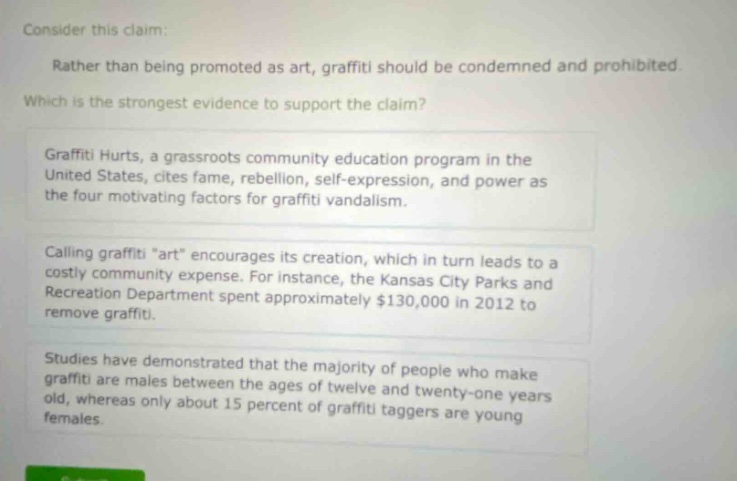
consider this claim: rather than being promoted as art, graffiti should be condemned and prohibited. which is the strongest evidence to support the claim? graffiti hurts, a grassroots community education program in the united states, cites fame, rebellion, self - expression, and power as the four motivating factors for graffiti vandalism. calling graffiti \art\ encourages its creation, which in turn leads to a costly community expense. for instance, the kansas city parks and recreation department spent approximately $130,000 in 2012 to remove graffiti. studies have demonstrated that the majority of people who make graffiti are males between the ages of twelve and twenty - one years old, whereas only about 15 percent of graffiti taggers are young females.
Answer
Brief Explanations:
The claim is that graffiti should be condemned and prohibited instead of being promoted as art. The second option provides evidence that promoting graffiti as art leads to costly community expenses for its removal, directly supporting the claim. The first option just lists motivations for graffiti vandalism without directly linking to the need for condemnation and prohibition. The third option gives demographic information about graffiti - makers which is not relevant to the claim.
Answer:
Calling graffiti "art" encourages its creation, which in turn leads to a costly community expense. For instance, the Kansas City Parks and Recreation Department spent approximately $130,000 in 2012 to remove graffiti.