consider the following method that is intended to modify its parameter namelist by replacing all occurrences…
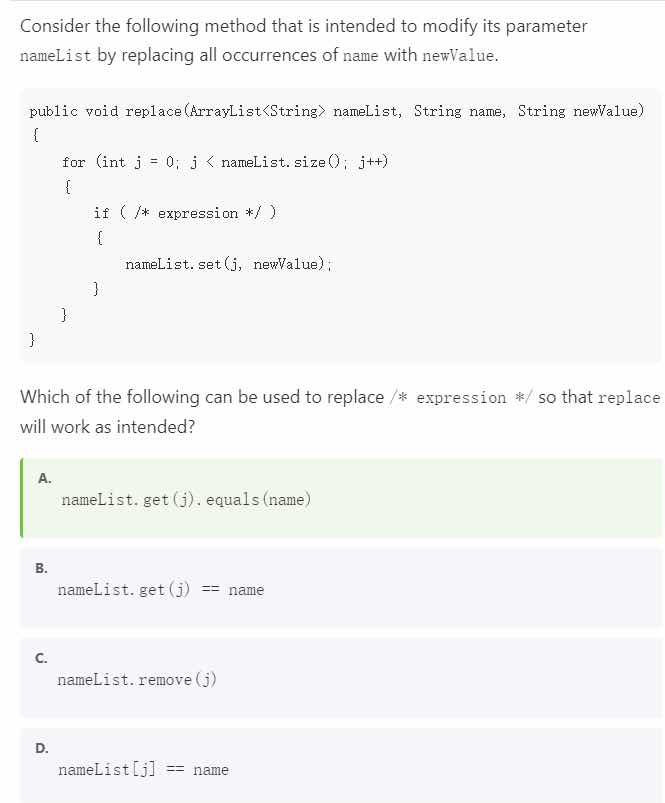
consider the following method that is intended to modify its parameter namelist by replacing all occurrences of name with newvalue.\npublic void replace(arraylist<string> namelist, string name, string newvalue)\n{\n for (int j = 0; j < namelist.size(); j++)\n {\n if ( /* expression */ )\n {\n namelist.set(j, newvalue);\n }\n }\n}\nwhich of the following can be used to replace /* expression */ so that replace will work as intended?\na. namelist.get(j).equals(name)\nb. namelist.get(j) == name\nc. namelist.remove(j)\nd. namelistj == name
Answer
Brief Explanations:
- Option A: Uses the
equals()method, which is the correct way to compare the content of String objects in Java, as it checks if the two strings have the same character sequence. - Option B: The
==operator compares object references, not string content. It will only return true if both variables point to the exact same String object, not just identical text, so it fails for most cases. - Option C: This is a method call to remove an element, not a boolean expression required for an
ifcondition, so it is invalid syntax here. - Option D:
nameListis an ArrayList, not an array, so the square bracket syntax[]cannot be used to access elements. Additionally, it uses==which has the same issue as Option B.
Answer:
A. nameList.get(j).equals(name)