investigation steps\n• place four cubes of sugar into a glass jar and place a lid on the jar.\n• shake the…
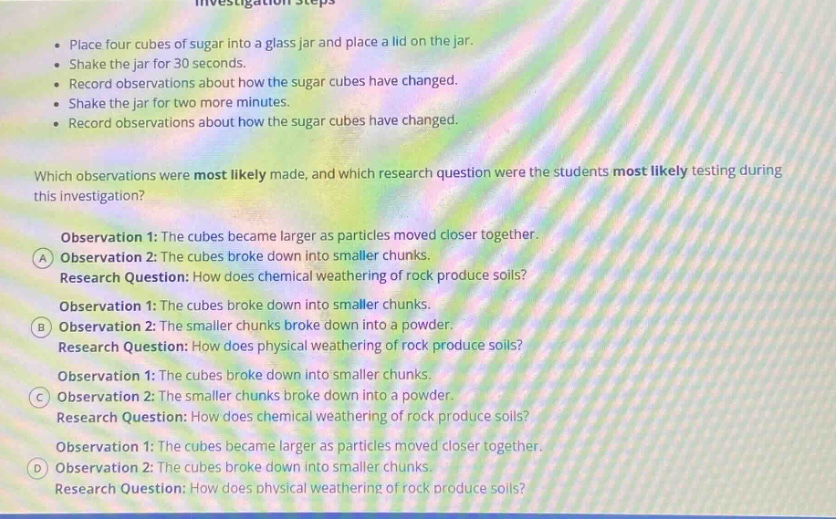
investigation steps\n• place four cubes of sugar into a glass jar and place a lid on the jar.\n• shake the jar for 30 seconds.\n• record observations about how the sugar cubes have changed.\n• shake the jar for two more minutes.\n• record observations about how the sugar cubes have changed.\nwhich observations were most likely made, and which research question were the students most likely testing during this investigation?\nobservation 1: the cubes became larger as particles moved closer together.\nobservation 2: the cubes broke down into smaller chunks.\nresearch question: how does chemical weathering of rock produce soils?\nobservation 1: the cubes broke down into smaller chunks.\nobservation 2: the smaller chunks broke down into a powder.\nresearch question: how does physical weathering of rock produce soils?\nobservation 1: the cubes broke down into smaller chunks.\nobservation 2: the smaller chunks broke down into a powder.\nresearch question: how does chemical weathering of rock produce soils?\nobservation 1: the cubes became larger as particles moved closer together.\nobservation 2: the cubes broke down into smaller chunks.\nresearch question: how does physical weathering of rock produce soils?
Answer
Brief Explanations:
Shaking sugar cubes in a jar is a physical process similar to physical weathering of rocks. Physical weathering breaks rocks into smaller pieces without changing their chemical composition. Sugar cubes breaking into smaller chunks and then into powder is a physical - breakdown process. Chemical weathering involves chemical changes, which is not the case here.
Answer:
B. Observation 1: The cubes broke down into smaller chunks. Observation 2: The smaller chunks broke down into a powder. Research Question: How does physical weathering of rock produce soils?