name date\n3 a student measures how far a marble rolls across a table when the table has different coverings…
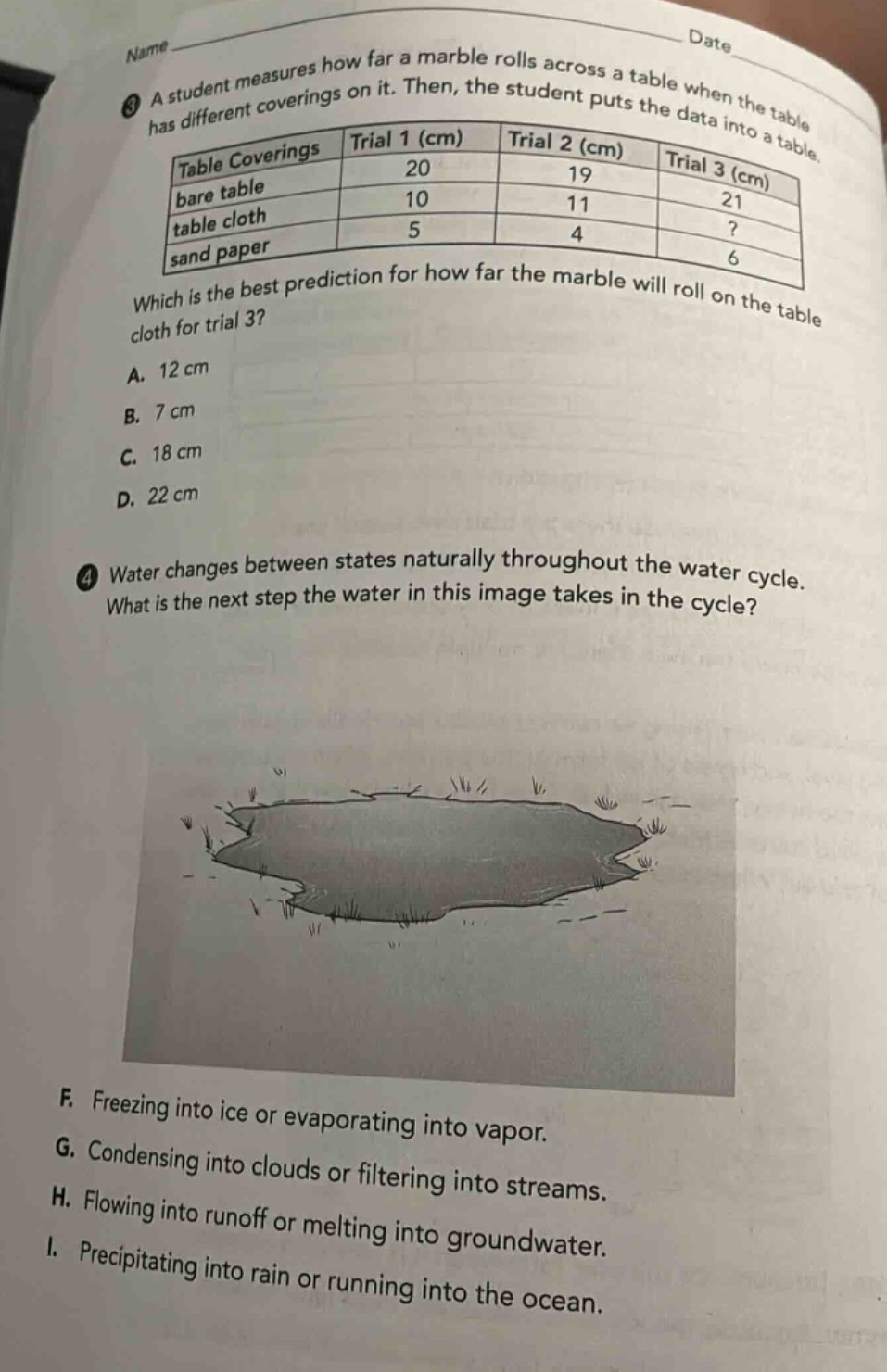
name date\n3 a student measures how far a marble rolls across a table when the table has different coverings on it. then, the student puts the data into a table.\n|table coverings|trial 1 (cm)|trial 2 (cm)|trial 3 (cm)|\n|----|----|----|----|\n|bare table|20|19|21|\n|table cloth|10|11|?|\n|sand paper|5|4|6|\nwhich is the best prediction for how far the marble will roll on the table cloth for trial 3?\na. 12 cm\nb. 7 cm\nc. 18 cm\nd. 22 cm\n4 water changes between states naturally throughout the water cycle. what is the next step the water in this image takes in the cycle?\nf. freezing into ice or evaporating into vapor.\ng. condensing into clouds or filtering into streams.\nh. flowing into runoff or melting into groundwater.\ni. precipitating into rain or running into the ocean.
Answer
Explanation:
Step1: Analyze table - cloth data trend
For table - cloth, the distances in trial 1 is 10 cm and in trial 2 is 11 cm. The values are relatively close and there is no large - scale increasing or decreasing trend.
Step2: Evaluate options
Option A (12 cm) is a reasonable value close to the previous two trial values. Option B (7 cm) is much lower than the previous values. Option C (18 cm) and Option D (22 cm) are much higher than the previous values.
Answer:
A. 12 cm
Explanation:
Step1: Recall water - cycle knowledge
The water in the pond can either freeze into ice (if the temperature is low enough) or evaporate into water vapor due to heat.
Step2: Evaluate options
Option F is correct as it mentions the two possible next steps in the water - cycle for the water in the pond. Option G is incorrect as condensation occurs after evaporation and filtering into streams is not a typical next step directly from a pond. Option H is incorrect as melting into groundwater is not a common next step from a pond and runoff is a different process. Option I is incorrect as precipitation is the opposite of what happens at this stage (water is leaving the pond surface) and running into the ocean is not an immediate next step.
Answer:
F. Freezing into ice or evaporating into vapor.