question 1\nhow do scientists use radioactive carbon, or c - 14, to date prehistoric objects?\na. they use…
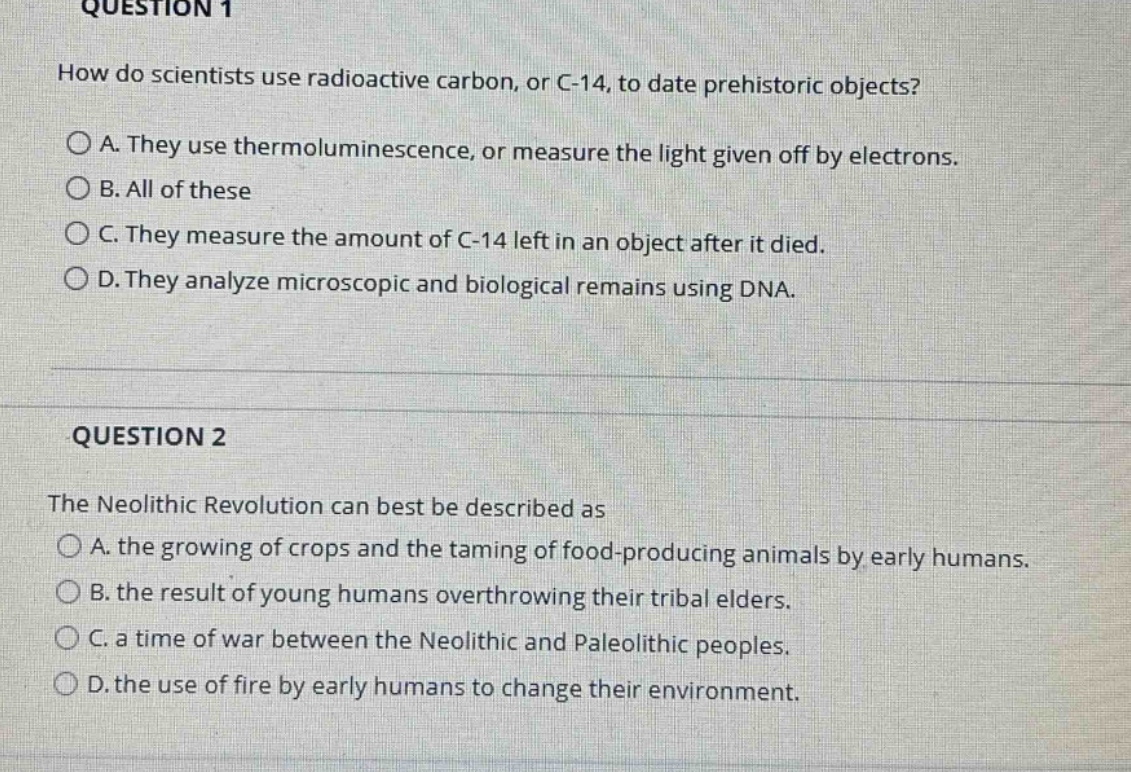
question 1\nhow do scientists use radioactive carbon, or c - 14, to date prehistoric objects?\na. they use thermoluminescence, or measure the light given off by electrons.\nb. all of these\nc. they measure the amount of c - 14 left in an object after it died.\nd. they analyze microscopic and biological remains using dna.\n\nquestion 2\nthe neolithic revolution can best be described as\na. the growing of crops and the taming of food - producing animals by early humans.\nb. the result of young humans overthrowing their tribal elders.\nc. a time of war between the neolithic and paleolithic peoples.\nd. the use of fire by early humans to change their environment.
Answer
Brief Explanations:
- For Question 1: Radiocarbon - dating measures the remaining C - 14 in a dead object. Thermoluminescence is a different dating method, and DNA analysis is not related to C - 14 dating.
- For Question 2: The Neolithic Revolution is characterized by the development of agriculture, including crop - growing and animal - taming. It was not about overthrowing tribal elders, war between Neolithic and Paleolithic peoples, or the use of fire for environmental change.
Answer:
Question 1: C. They measure the amount of C-14 left in an object after it died. Question 2: A. the growing of crops and the taming of food - producing animals by early humans.