question 3\nwhich is true of inducements in research?\ninducements constitute an “undue influence” if they…
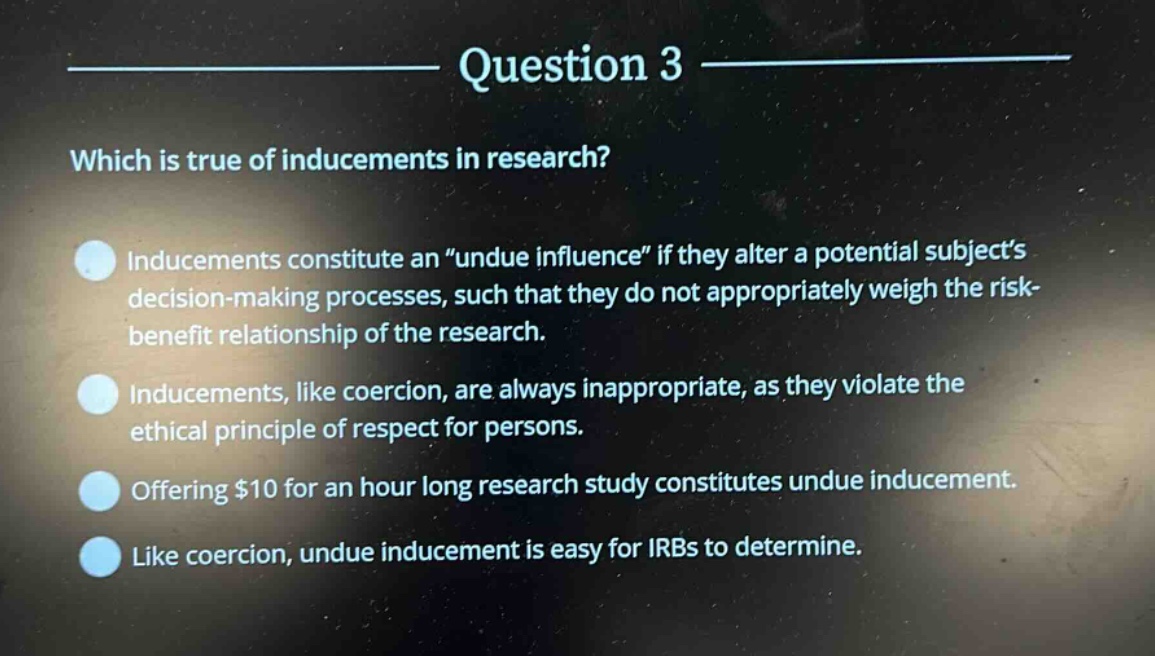
question 3\nwhich is true of inducements in research?\ninducements constitute an “undue influence” if they alter a potential subject’s decision - making processes, such that they do not appropriately weigh the risk - benefit relationship of the research.\ninducements, like coercion, are always inappropriate, as they violate the ethical principle of respect for persons.\noffering $10 for an hour long research study constitutes undue inducement.\nlike coercion, undue inducement is easy for irbs to determine.
Answer
Brief Explanations:
Inducements in research are unethical when they distort a potential subject's decision - making regarding the research's risk - benefit ratio. Coercion and inducements are different, and what constitutes undue inducement can be subjective. Offering a small amount like $10 for an hour - long study may not always be undue. Determining undue inducement is not always straightforward for Institutional Review Boards (IRBs).
Answer:
Inducements constitute an “undue influence” if they alter a potential subject’s decision - making processes, such that they do not appropriately weigh the risk - benefit relationship of the research.