5. radioactive radium has a half - life of approximately 1599 years. what percent of a given amount remains…
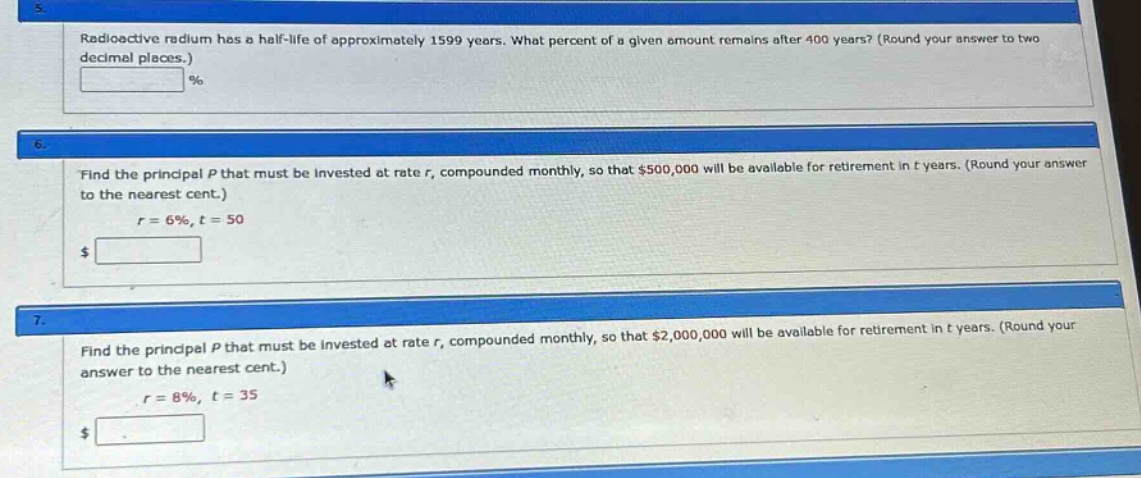
5. radioactive radium has a half - life of approximately 1599 years. what percent of a given amount remains after 400 years? (round your answer to two decimal places.) % 6. find the principal p that must be invested at rate r, compounded monthly, so that $500,000 will be available for retirement in t years. (round your answer to the nearest cent.) r = 6%, t = 50 $ 7. find the principal p that must be invested at rate r, compounded monthly, so that $2,000,000 will be available for retirement in t years. (round your answer to the nearest cent.) r = 8%, t = 35 $
Answer
5.
Explanation:
Step1: Recall the radioactive - decay formula
The formula for radioactive decay is $A = A_0(\frac{1}{2})^{\frac{t}{h}}$, where $A$ is the amount remaining, $A_0$ is the initial amount, $t$ is the time elapsed, and $h$ is the half - life. We want to find the percentage, so we calculate $\frac{A}{A_0}\times100%$. Here, $h = 1599$ years and $t = 400$ years. $\frac{A}{A_0}=(\frac{1}{2})^{\frac{t}{h}}=(\frac{1}{2})^{\frac{400}{1599}}$
Step2: Calculate the value
Using a calculator, $(\frac{1}{2})^{\frac{400}{1599}}=2^{-\frac{400}{1599}}\approx0.8305$. Then, the percentage is $0.8305\times100% = 83.05%$
Answer:
$83.05$
6.
Explanation:
Step1: Recall the compound - interest formula
The compound - interest formula is $A=P(1 +\frac{r}{n})^{nt}$, where $A$ is the final amount, $P$ is the principal, $r$ is the annual interest rate (in decimal form), $n$ is the number of times compounded per year, and $t$ is the number of years. Here, $n = 12$ (compounded monthly), $A = 500000$, $r=0.06$, and $t = 50$. We need to solve for $P$. $P=\frac{A}{(1+\frac{r}{n})^{nt}}$
Step2: Substitute the values
$P=\frac{500000}{(1+\frac{0.06}{12})^{12\times50}}=\frac{500000}{(1 + 0.005)^{600}}$
Step3: Calculate the value
$(1 + 0.005)^{600}\approx19.7993$. Then $P=\frac{500000}{19.7993}\approx25252.37$
Answer:
$25252.37$
7.
Explanation:
Step1: Recall the compound - interest formula
Using the compound - interest formula $A = P(1+\frac{r}{n})^{nt}$, with $n = 12$ (compounded monthly), $A = 2000000$, $r = 0.08$, and $t=35$. We solve for $P$, so $P=\frac{A}{(1+\frac{r}{n})^{nt}}$
Step2: Substitute the values
$P=\frac{2000000}{(1+\frac{0.08}{12})^{12\times35}}=\frac{2000000}{(1+\frac{1}{150})^{420}}$
Step3: Calculate the value
$(1+\frac{1}{150})^{420}\approx17.5353$. Then $P=\frac{2000000}{17.5353}\approx114055.65$
Answer:
$114055.65$