write p (p wave), s (s wave), l (love wave) and/or r (rayleigh wave) as they apply to each picture or…
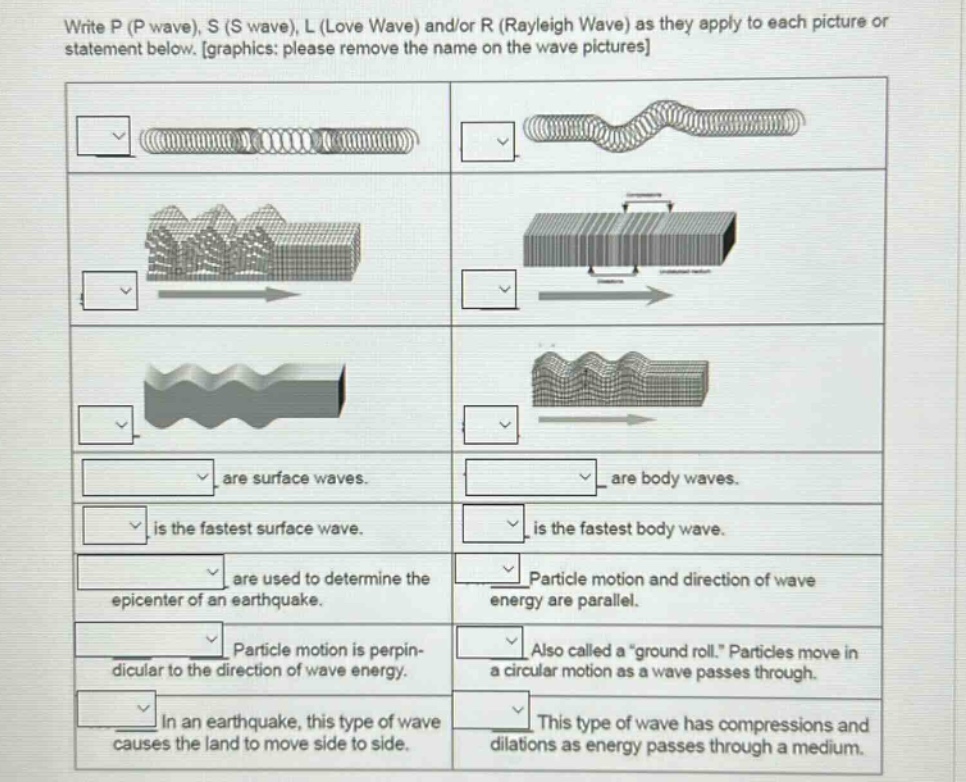
write p (p wave), s (s wave), l (love wave) and/or r (rayleigh wave) as they apply to each picture or statement below. graphics: please remove the name on the wave pictures\nare surface waves.\nare body waves.\nis the fastest surface wave.\nis the fastest body wave.\nare used to determine the epicenter of an earthquake.\nparticle motion and direction of wave energy are parallel.\nparticle motion is perpendicular to the direction of wave energy.\nalso called a “ground roll.” particles move in a circular motion as a wave passes through.\nin an earthquake, this type of wave causes the land to move side to side.\nthis type of wave has compressions and dilations as energy passes through a medium.
Answer
Brief Explanations:
- P - waves (primary waves) are body waves, the fastest body - waves, and have particle motion parallel to the direction of wave energy. They have compressions and dilations as energy passes through a medium.
- S - waves (secondary waves) are body waves, with particle motion perpendicular to the direction of wave energy.
- L - waves (Love waves) are surface waves and cause the land to move side - to - side.
- R - waves (Rayleigh waves) are surface waves, also called "ground roll", with particles moving in a circular motion as the wave passes through. P and S waves are used to determine the epicenter of an earthquake, and R is the fastest surface wave among them.
Answer:
- First row left: P
- First row right: S
- Second row left: L
- Second row right: R
- Third row left: L, R
- Third row right: P, S
- Fourth row left: R
- Fourth row right: P
- Fifth row left: P, S
- Fifth row right: P
- Sixth row left: S
- Sixth row right: R
- Seventh row left: L
- Seventh row right: P