10. a balloon that contains 0.500 l of helium at 25 °c is cooled to 11 °c, at a constant pressure. what…
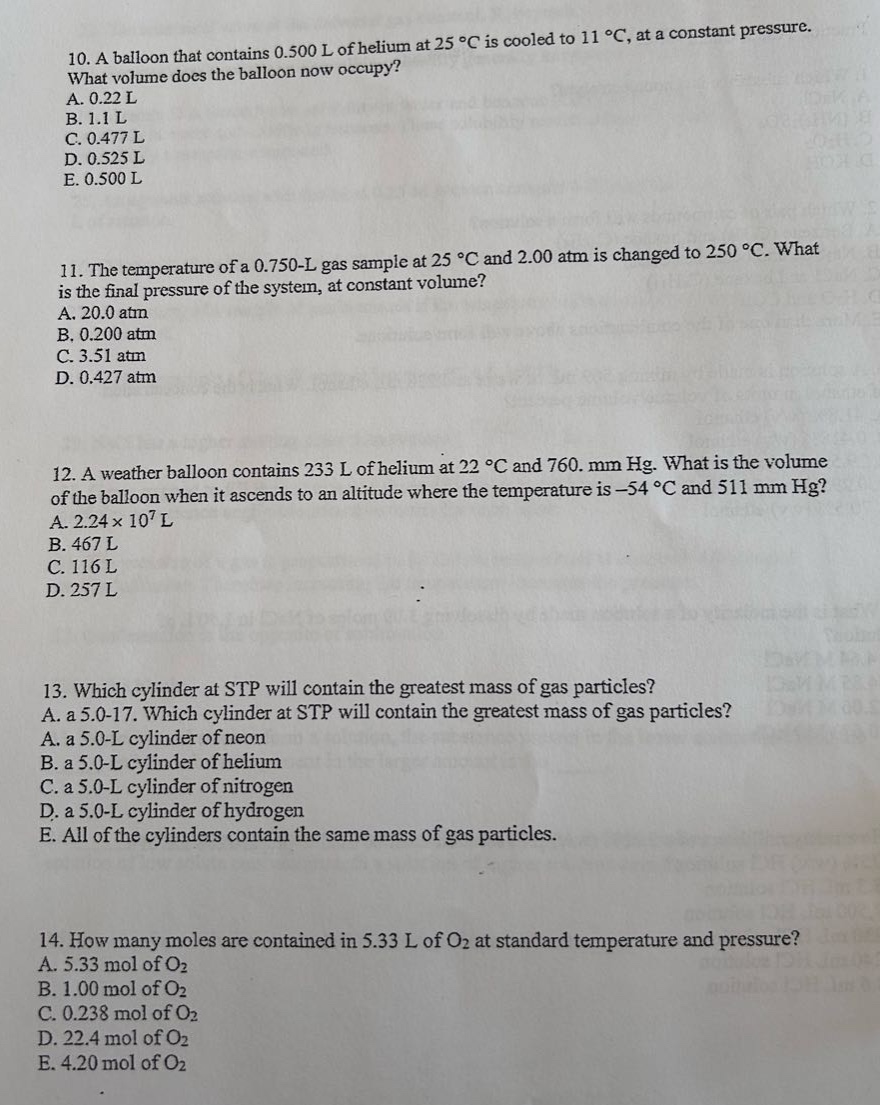
10. a balloon that contains 0.500 l of helium at 25 °c is cooled to 11 °c, at a constant pressure. what volume does the balloon now occupy?\na. 0.22 l\nb. 1.1 l\nc. 0.477 l\nd. 0.525 l\ne. 0.500 l\n\n11. the temperature of a 0.750 - l gas sample at 25 °c and 2.00 atm is changed to 250 °c. what is the final pressure of the system, at constant volume?\na. 20.0 atm\nb. 0.200 atm\nc. 3.51 atm\nd. 0.427 atm\n\n12. a weather balloon contains 233 l of helium at 22 °c and 760. mm hg. what is the volume of the balloon when it ascends to an altitude where the temperature is - 54 °c and 511 mm hg?\na. 2.24×10⁷ l\nb. 467 l\nc. 116 l\nd. 257 l\n\n13. which cylinder at stp will contain the greatest mass of gas particles?\na. a 5.0 - l cylinder of neon\nb. a 5.0 - l cylinder of helium\nc. a 5.0 - l cylinder of nitrogen\nd. a 5.0 - l cylinder of hydrogen\ne. all of the cylinders contain the same mass of gas particles.\n\n14. how many moles are contained in 5.33 l of o₂ at standard temperature and pressure?\na. 5.33 mol of o₂\nb. 1.00 mol of o₂\nc. 0.238 mol of o₂\nd. 22.4 mol of o₂\ne. 4.20 mol of o₂
Answer
10.
Explanation:
Step1: Convert temperatures to Kelvin
$T_1 = 25 + 273 = 298\ K$, $T_2=11 + 273 = 284\ K$
Step2: Apply Charles's law ($\frac{V_1}{T_1}=\frac{V_2}{T_2}$)
$V_2=\frac{V_1T_2}{T_1}=\frac{0.500\times284}{298}\approx0.477\ L$
Answer:
C. 0.477 L
11.
Explanation:
Step1: Convert temperatures to Kelvin
$T_1 = 25+ 273=298\ K$, $T_2 = 250+273 = 523\ K$
Step2: Apply Gay - Lussac's law ($\frac{P_1}{T_1}=\frac{P_2}{T_2}$)
$P_2=\frac{P_1T_2}{T_1}=\frac{2.00\times523}{298}\approx3.51\ atm$
Answer:
C. 3.51 atm
12.
Explanation:
Step1: Convert temperatures to Kelvin and pressures to atm
$T_1 = 22+273 = 295\ K$, $P_1 = 760\ mmHg=1\ atm$, $V_1 = 233\ L$ $T_2=- 54 + 273=219\ K$, $P_2 = 511\ mmHg=\frac{511}{760}\ atm\approx0.672\ atm$
Step2: Apply the combined - gas law ($\frac{P_1V_1}{T_1}=\frac{P_2V_2}{T_2}$)
$V_2=\frac{P_1V_1T_2}{P_2T_1}=\frac{1\times233\times219}{0.672\times295}\approx257\ L$
Answer:
D. 257 L
13.
Explanation:
Step1: Recall molar mass and Avogadro's law at STP
At STP, equal volumes of gases contain equal number of moles. Molar mass of neon ($Ne$) is $M_{Ne}=20.18\ g/mol$, helium ($He$) is $M_{He} = 4.00\ g/mol$, nitrogen ($N_2$) is $M_{N_2}=28.02\ g/mol$, hydrogen ($H_2$) is $M_{H_2}=2.02\ g/mol$. Since $n=\frac{m}{M}$ and $V$ is the same (5.0 L at STP), more molar - mass means more mass. Nitrogen has the highest molar mass among them.
Answer:
C. a 5.0 - L cylinder of nitrogen
14.
Explanation:
Step1: Recall the molar volume at STP
At STP, the molar volume of a gas is $V_m = 22.4\ L/mol$.
Step2: Calculate the number of moles
$n=\frac{V}{V_m}=\frac{5.33}{22.4}\approx0.238\ mol$
Answer:
C. 0.238 mol of $O_2$