10. the diagram below identifies three structures found in the human body. which level of organization…
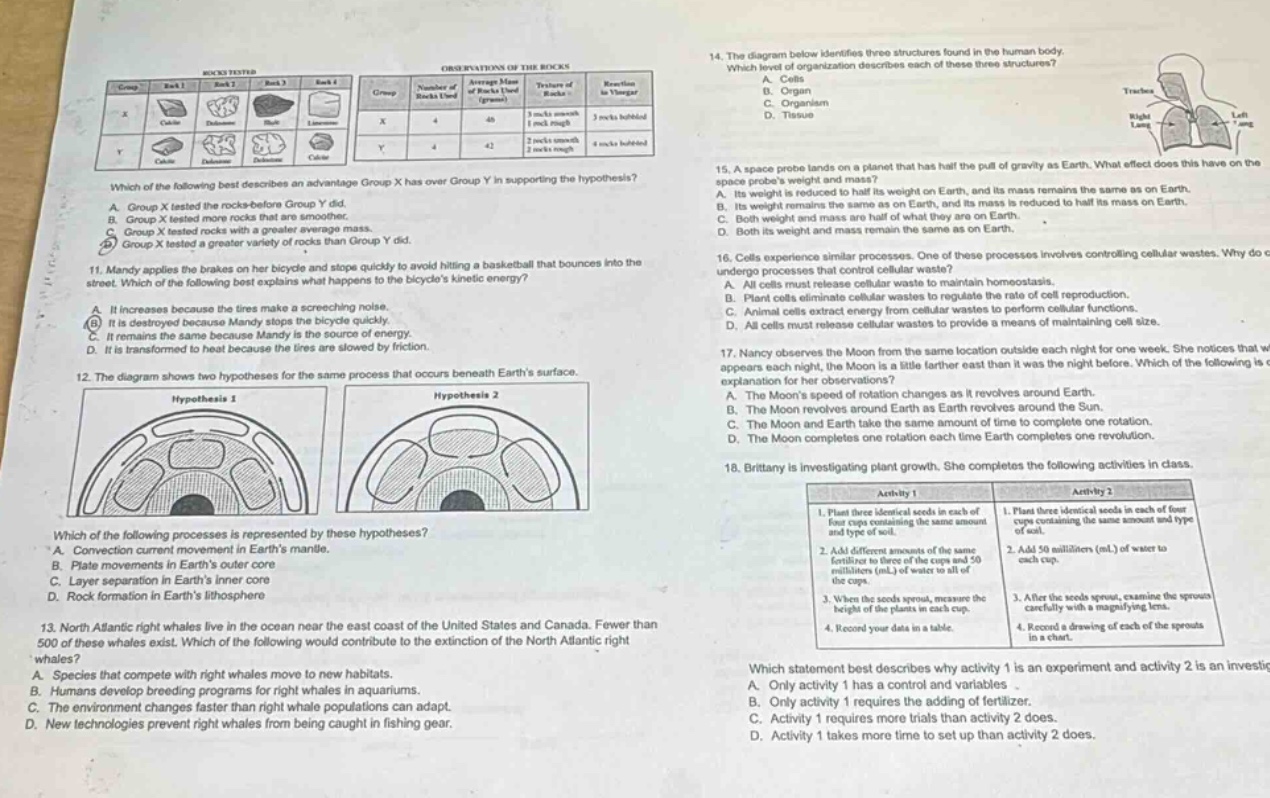
10. the diagram below identifies three structures found in the human body. which level of organization describes each of these three structures? a. cells b. organ c. organism d. tissue\n11. mandy applies the brakes on her bicycle and stops quickly to avoid hitting a basketball that bounces into the street. which of the following best explains what happens to the bicycles kinetic energy? a. it increases because the tires make a screeching noise. b. it is destroyed because mandy stops the bicycle quickly. c. it remains the same because mandy is the source of energy. d. it is transformed to heat because the tires are slowed by friction.\n12. the diagram shows two hypotheses for the same process that occurs beneath earths surface. which of the following processes is represented by these hypotheses? a. convection current movement in earths mantle. b. plate movements in earths outer core. c. layer separation in earths inner core. d. rock formation in earths lithosphere.\n13. north atlantic right whales live in the ocean near the east coast of the united states and canada. fewer than 500 of these whales exist. which of the following would contribute to the extinction of the north atlantic right whales? a. species that compete with right whales move to new habitats. b. humans develop breeding programs for right whales in aquariums. c. the environment changes faster than right whale populations can adapt. d. new technologies prevent right whales from being caught in fishing gear.\n14. the diagram below identifies three structures found in the human body. which level of organization describes each of these three structures? a. cells b. organ c. organism d. tissue\n15. a space probe lands on a planet that has half the pull of gravity as earth. what effect does this have on the space probes weight and mass? a. its weight is reduced to half its weight on earth, and its mass remains the same as on earth. b. its weight remains the same as on earth, and its mass is reduced to half its mass on earth. c. both weight and mass are half of what they are on earth. d. both its weight and mass remain the same as on earth.\n16. cells experience similar processes. one of these processes involves controlling cellular wastes. why do cells undergo processes that control cellular waste? a. all cells must release cellular waste to maintain homeostasis. b. plant cells eliminate cellular waste to regulate activity of cell reproduction. c. animal cells must release energy from cellular wastes to perform cellular functions. d. all cells must release cellular waste to provide a means of maintaining cell size.\n17. nancy observes the moon from the same location outside each night for one week. she notices that it appears each night, the moon is a little farther east than it was the night before. which of the following is an explanation for her observations? a. the moons speed of rotation changes as it revolves around earth. b. the moon revolves around earth as earth revolves around the sun. c. the moon and earth take the same amount of time to complete one rotation. d. the moon completes one rotation around earth each time earth completes one rotation.\n18. brittany is investigating plant growth. she completes the following activities in class. activity 1: 1. plant three identical seeds in each of four cups containing the same amount and type of soil. 2. add different amounts of the same fertilizer to three of the cups and 50 milliliters (ml) of water to all of the cups. 3. when the seeds sprout, measure the height of the plants in each cup. 4. record your data in a table. activity 2: 1. plant three identical seeds in each of four cups containing the same amount and type of soil. 2. add 50 milliliters (ml) of water to each cup. 3. after the seeds sprout, examine the sprouts carefully with a magnifying lens. 4. record a drawing of each of the sprouts in a chart. which statement best describes why activity 1 is an experiment and activity 2 is an investigation? a. only activity 1 has a control and variables. b. only activity 1 requires the adding of fertilizer. c. activity 1 requires more trials than activity 2 does. d. activity 1 takes more time to set up than activity 2 does.
Answer
Explanation:
Step1: Analyze the data in the table
Group X has a greater variety of rocks in terms of texture and reaction in vinegar compared to Group Y.
Step2: Evaluate each option
A is about testing order, not relevant. B is about smoothness, not key. C is about average mass, not decisive. D about variety is correct.
Answer:
D. Group X tested a greater variety of rocks than Group Y did.
Explanation:
Step1: Recall the concept of kinetic - energy
When Mandy applies brakes, friction acts.
Step2: Understand energy transformation
Kinetic energy is transformed to heat due to friction.
Answer:
D. It is transformed to heat because the tires are slowed by friction.
Explanation:
Step1: Observe the hypotheses diagrams
The diagrams show circular - like movements beneath Earth's surface.
Step2: Match with geological processes
This represents convection current movement in Earth's mantle.
Answer:
A. Convection current movement in Earth's mantle.
Explanation:
Step1: Analyze each option for factors affecting extinction
A and D are positive for right - whales. B is a conservation effort. C means rapid environmental change they can't adapt to.
Answer:
C. The environment changes faster than right whale populations can adapt.
Explanation:
Step1: Identify the structures in the diagram
The structures are trachea, lungs, and diaphragm.
Step2: Recall levels of organization
These are organs.
Answer:
B. Organ
Explanation:
Step1: Recall the definitions of weight and mass
Weight is the force due to gravity ($W = mg$), mass is the amount of matter.
Step2: Analyze the effect of gravity change
On a planet with half the gravity of Earth, weight is halved, mass remains the same.
Answer:
A. Its weight is reduced to half its weight on Earth, and its mass remains the same as on Earth.
Explanation:
Step1: Understand the function of cells in waste - handling
All cells release cellular waste to maintain homeostasis.
Step2: Evaluate each option
A is correct. B is about cell reproduction, C is about energy for functions, D is about maintaining cell size.
Answer:
A. All cells must release cellular waste to maintain homeostasis.
Explanation:
Step1: Recall the movement of the Moon
The Moon revolves around Earth as Earth rotates.
Step2: Analyze the position change
The Moon appears farther east each night because it revolves around Earth as Earth rotates.
Answer:
B. The Moon revolves around Earth as Earth rotates around the Sun.
Explanation:
Step1: Define experiment and investigation
An experiment has a control and variables. Activity 1 has different amounts of fertilizer (variable) and a control (no - fertilizer cup).
Step2: Evaluate each option
A is correct. B is not the main difference, C is not true, D is not the key factor.
Answer:
A. Only activity 1 has a control and variables.