6. a 0.100 kg mass is attached to a string 75 cm long and swings in a horizontal circle, revolving once…
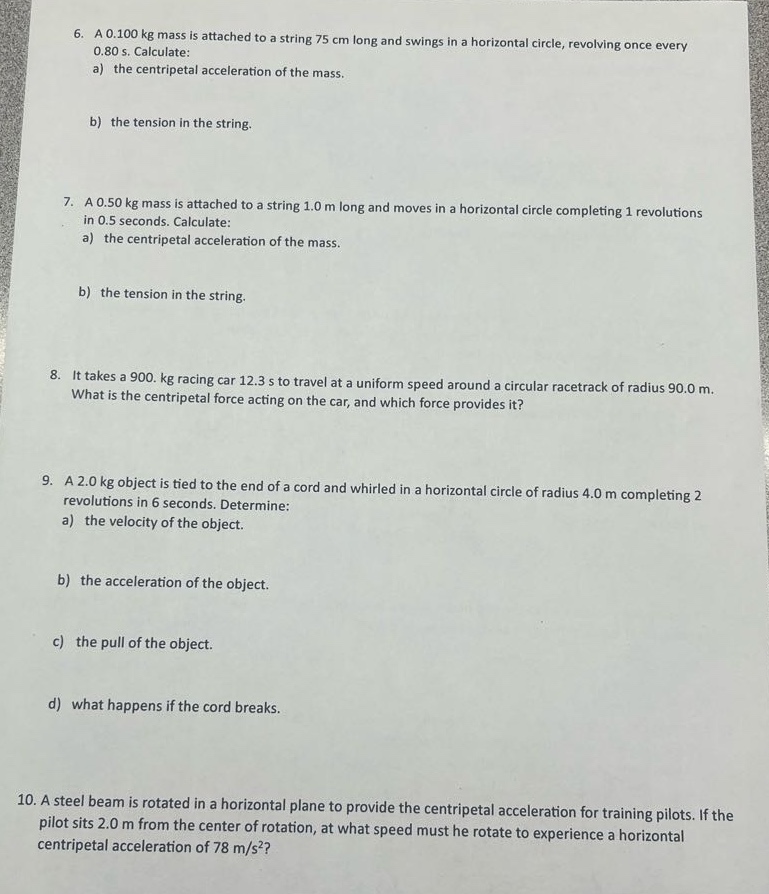
6. a 0.100 kg mass is attached to a string 75 cm long and swings in a horizontal circle, revolving once every 0.80 s. calculate:\na) the centripetal acceleration of the mass.\nb) the tension in the string.\n7. a 0.50 kg mass is attached to a string 1.0 m long and moves in a horizontal circle completing 1 revolutions in 0.5 seconds. calculate:\na) the centripetal acceleration of the mass.\nb) the tension in the string.\n8. it takes a 900. kg racing car 12.3 s to travel at a uniform speed around a circular racetrack of radius 90.0 m. what is the centripetal force acting on the car, and which force provides it?\n9. a 2.0 kg object is tied to the end of a cord and whirled in a horizontal circle of radius 4.0 m completing 2 revolutions in 6 seconds. determine:\na) the velocity of the object.\nb) the acceleration of the object.\nc) the pull of the object.\nd) what happens if the cord breaks.\n10. a steel beam is rotated in a horizontal plane to provide the centripetal acceleration for training pilots. if the pilot sits 2.0 m from the center of rotation, at what speed must he rotate to experience a horizontal centripetal acceleration of 78 m/s²?
Answer
Problem 6
Explanation:
Step1: Find the angular velocity $\omega$
The mass revolves once every $T = 0.80\ s$. The angular velocity $\omega=\frac{2\pi}{T}$. $\omega=\frac{2\pi}{0.80}\ rad/s\approx 7.85\ rad/s$
Step2: Calculate the centripetal acceleration $a_c$
The radius $r = 75\ cm=0.75\ m$. The formula for centripetal - acceleration is $a_c=\omega^{2}r$. $a_c=(7.85)^{2}\times0.75\ m/s^{2}\approx46.3\ m/s^{2}$
Step3: Find the tension in the string $T$
The tension in the string provides the centripetal force $F_c = ma_c$. Given $m = 0.100\ kg$. $T=F_c=ma_c=0.100\ kg\times46.3\ m/s^{2}=4.63\ N$
Answer:
a) $46.3\ m/s^{2}$ b) $4.63\ N$
Problem 7
Explanation:
Step1: Find the angular velocity $\omega$
The mass completes 1 revolution in $T = 0.5\ s$. The angular velocity $\omega=\frac{2\pi}{T}$. $\omega=\frac{2\pi}{0.5}\ rad/s = 4\pi\ rad/s\approx12.57\ rad/s$
Step2: Calculate the centripetal acceleration $a_c$
The radius $r = 1.0\ m$. The formula for centripetal - acceleration is $a_c=\omega^{2}r$. $a_c=(12.57)^{2}\times1.0\ m/s^{2}\approx158\ m/s^{2}$
Step3: Find the tension in the string $T$
The tension in the string provides the centripetal force $F_c = ma_c$. Given $m = 0.50\ kg$. $T=F_c=ma_c=0.50\ kg\times158\ m/s^{2}=79\ N$
Answer:
a) $158\ m/s^{2}$ b) $79\ N$
Problem 8
Explanation:
Step1: Find the speed $v$ of the car
The car travels around a circular track of radius $r = 90.0\ m$ in $t = 12.3\ s$. The circumference of the circle is $C = 2\pi r$. The speed $v=\frac{2\pi r}{t}$. $v=\frac{2\pi\times90.0}{12.3}\ m/s\approx46.1\ m/s$
Step2: Calculate the centripetal force $F_c$
The formula for centripetal force is $F_c=\frac{mv^{2}}{r}$, where $m = 900\ kg$. $F_c=\frac{900\times(46.1)^{2}}{90.0}\ N\approx21258.1\ N$ The frictional force between the tires and the road provides the centripetal force.
Answer:
The centripetal force is approximately $21258.1\ N$, and the frictional force provides it.
Problem 9
Explanation:
Step1: Find the angular velocity $\omega$
The object completes 2 revolutions in $t = 6\ s$. The angular velocity $\omega=\frac{2\times2\pi}{6}\ rad/s=\frac{2\pi}{3}\ rad/s\approx2.09\ rad/s$
Step2: Calculate the velocity $v$ of the object
The radius $r = 4.0\ m$. The formula for linear velocity is $v=\omega r$. $v = 2.09\times4.0\ m/s\approx8.37\ m/s$
Step3: Calculate the acceleration $a$ of the object
The centripetal - acceleration formula is $a=\omega^{2}r$. $a=(2.09)^{2}\times4.0\ m/s^{2}\approx17.5\ m/s^{2}$
Step4: Find the pull (centripetal force) $F$ of the object
The centripetal force formula is $F = ma$, where $m = 2.0\ kg$. $F=2.0\ kg\times17.5\ m/s^{2}=35\ N$
Step5: Determine what happens if the cord breaks
If the cord breaks, the centripetal force acting on the object disappears. According to Newton's first law, the object will move in a straight - line path tangent to the circular path at the point where the cord breaks.
Answer:
a) $8.37\ m/s$ b) $17.5\ m/s^{2}$ c) $35\ N$ d) The object will move in a straight - line path tangent to the circular path at the point of breakage.
Problem 10
Explanation:
Step1: Use the centripetal - acceleration formula
The centripetal - acceleration formula is $a_c=\frac{v^{2}}{r}$. We need to solve for $v$, given $a_c = 78\ m/s^{2}$ and $r = 2.0\ m$. Rearranging the formula for $v$, we get $v=\sqrt{a_cr}$. $v=\sqrt{78\times2.0}\ m/s=\sqrt{156}\ m/s\approx12.5\ m/s$
Answer:
The speed is approximately $12.5\ m/s$.