105. what are electromagnetic waves?\n106. electromagnetic waves vary in ...\n107. is light a wave or a…
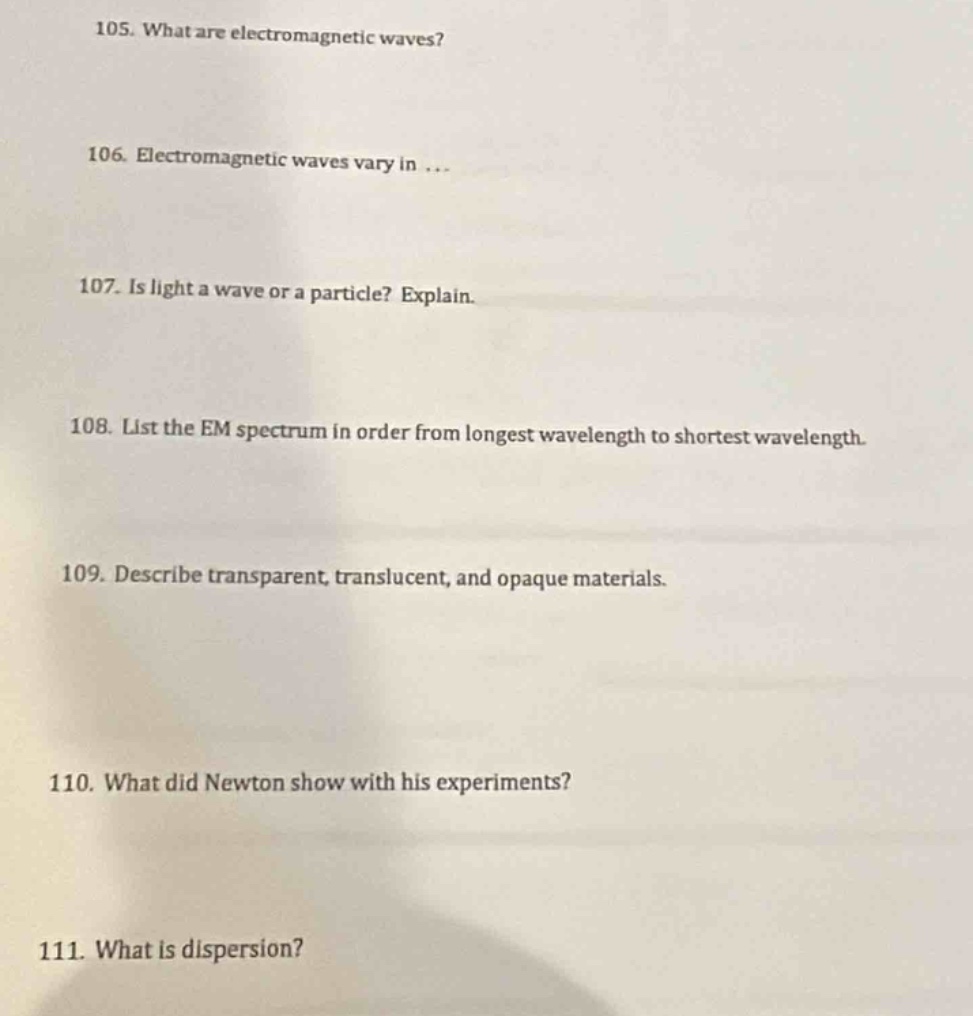
105. what are electromagnetic waves?\n106. electromagnetic waves vary in ...\n107. is light a wave or a particle? explain.\n108. list the em spectrum in order from longest wavelength to shortest wavelength.\n109. describe transparent, translucent, and opaque materials.\n110. what did newton show with his experiments?\n111. what is dispersion?
Answer
Brief Explanations:
- Electromagnetic waves are waves created by oscillating electric and magnetic fields that can travel through a vacuum or a medium. They are a combination of electric and magnetic fields that are perpendicular to each other and to the direction of wave - propagation.
- Electromagnetic waves vary in wavelength, frequency, and energy. Wavelength and frequency are inversely related, and energy is directly related to frequency.
- Light has a dual - nature. It can behave as a wave, as shown by phenomena like interference and diffraction. It can also behave as a particle (photons), as demonstrated by the photoelectric effect.
- The EM spectrum from longest to shortest wavelength: radio waves, microwaves, infrared, visible light, ultraviolet, X - rays, gamma rays.
- Transparent materials allow light to pass through with little absorption or scattering, so objects behind can be clearly seen. Translucent materials allow some light to pass through but scatter it, so objects behind appear blurry. Opaque materials do not allow light to pass through.
- Newton showed with his prism experiments that white light is composed of a spectrum of colors. He demonstrated the dispersion of light.
- Dispersion is the separation of white light into its component colors (spectrum) due to the different refractive indices of the colors in a medium like a prism.
Answer:
- Waves created by oscillating electric and magnetic fields that can travel through a vacuum or medium.
- Wavelength, frequency, and energy.
- Light has a dual - nature. It can behave as a wave (interference, diffraction) and as a particle (photoelectric effect).
- Radio waves, microwaves, infrared, visible light, ultraviolet, X - rays, gamma rays.
- Transparent: allow light to pass through with little absorption or scattering; Translucent: allow some light to pass through but scatter it; Opaque: do not allow light to pass through.
- White light is composed of a spectrum of colors.
- The separation of white light into its component colors due to different refractive indices in a medium.