a 1090 kg car moving +11.0 m/s makes a head - on inelastic collision with a stationary car. after, they move…
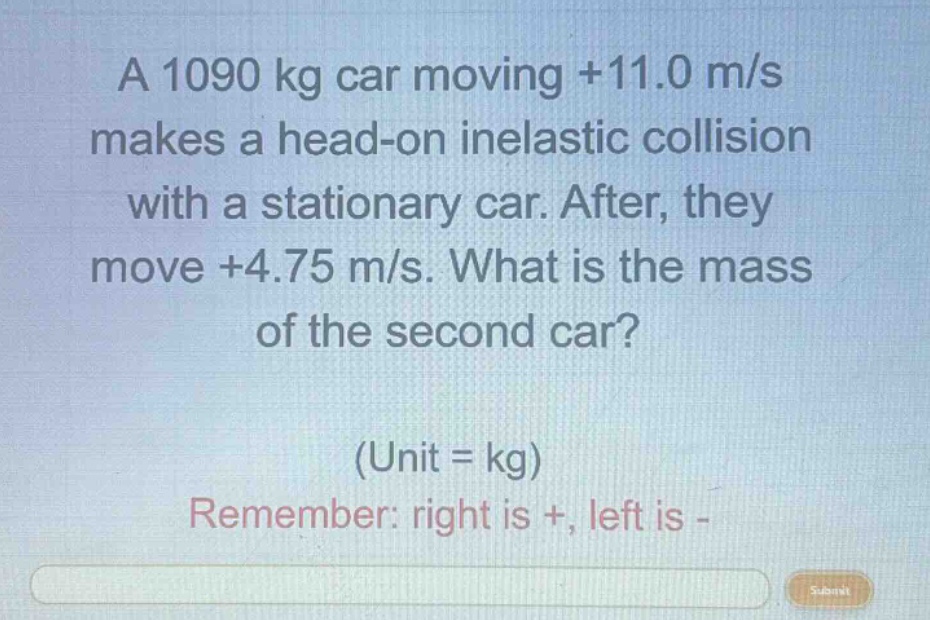
a 1090 kg car moving +11.0 m/s makes a head - on inelastic collision with a stationary car. after, they move +4.75 m/s. what is the mass of the second car? (unit = kg) remember: right is +, left is -
Answer
Explanation:
Step1: Apply the law of conservation of momentum
For an inelastic collision, the formula is (m_1v_1 + m_2v_2=(m_1 + m_2)v_f). Given (m_1 = 1090\space kg), (v_1=11.0\space m/s), (v_2 = 0\space m/s) (stationary), and (v_f=4.75\space m/s). Substitute the values into the formula: (1090\times11.0+m_2\times0=(1090 + m_2)\times4.75).
Step2: Simplify the equation
The equation becomes (1090\times11.0 = 1090\times4.75+4.75m_2). Calculate (1090\times11.0 = 11990) and (1090\times4.75=5177.5). So, (11990=5177.5 + 4.75m_2).
Step3: Solve for (m_2)
Subtract (5177.5) from both sides: (11990 - 5177.5=4.75m_2). (6812.5 = 4.75m_2). Then (m_2=\frac{6812.5}{4.75}).
Answer:
(1434.21\space kg)