122. what causes light to refract?\n123. describe the difference between a plane mirror, a concave mirror…
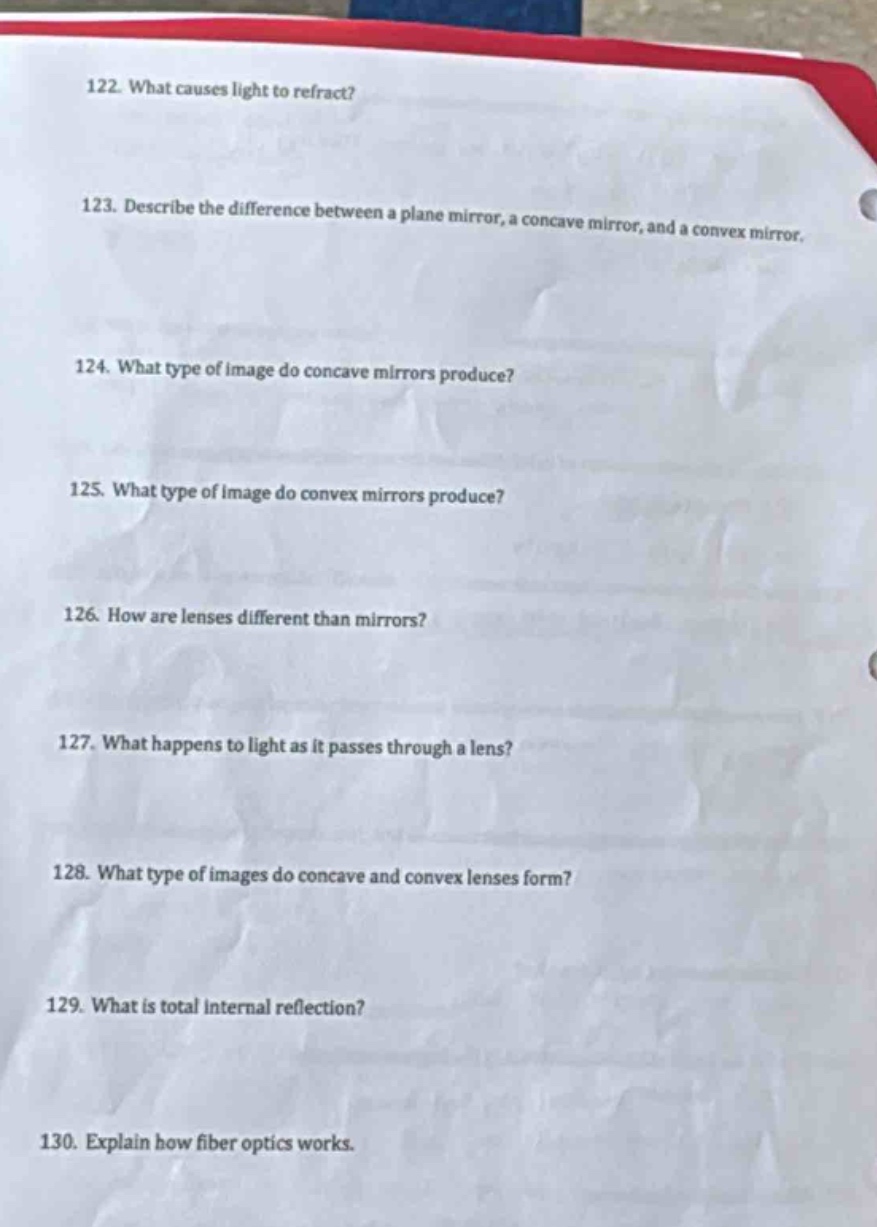
122. what causes light to refract?\n123. describe the difference between a plane mirror, a concave mirror, and a convex mirror.\n124. what type of image do concave mirrors produce?\n125. what type of image do convex mirrors produce?\n126. how are lenses different than mirrors?\n127. what happens to light as it passes through a lens?\n128. what type of images do concave and convex lenses form?\n129. what is total internal reflection?\n130. explain how fiber optics works.
Answer
Brief Explanations:
- Light refracts due to a change in speed when passing from one medium to another with a different optical density.
- A plane mirror has a flat surface and forms virtual, upright, and same - sized images. A concave mirror is curved inward and can form real or virtual, upright or inverted, and magnified or reduced images depending on the object's position. A convex mirror is curved outward and always forms virtual, upright, and reduced images.
- Concave mirrors can produce real, inverted, and magnified or reduced images when the object is beyond the focal point, and virtual, upright, and magnified images when the object is within the focal point.
- Convex mirrors always produce virtual, upright, and reduced images.
- Lenses refract light as it passes through them, while mirrors reflect light from their surface.
- Light refracts as it passes through a lens, either converging (convex lens) or diverging (concave lens) the light rays.
- Concave lenses form virtual, upright, and reduced images. Convex lenses can form real, inverted, and magnified or reduced images when the object is beyond the focal point, and virtual, upright, and magnified images when the object is within the focal point.
- Total internal reflection occurs when light travels from a medium with a higher refractive index to one with a lower refractive index and the angle of incidence is greater than the critical angle, causing all the light to be reflected back into the first medium.
- Fiber optics works based on total internal reflection. Light is sent into a thin fiber made of a high - refractive - index material surrounded by a lower - refractive - index cladding. The light bounces along the fiber due to total internal reflection, allowing for the transmission of information over long distances with minimal loss.
Answer:
- Change in speed due to different optical density of media.
- Plane mirror: flat surface, virtual/upright/same - sized images; Concave mirror: curved inward, real/virtual, upright/inverted, magnified/reduced images depending on object position; Convex mirror: curved outward, virtual/upright/reduced images always.
- Real, inverted, magnified/reduced (object beyond focal point); virtual, upright, magnified (object within focal point).
- Virtual, upright, reduced images always.
- Lenses refract light, mirrors reflect light[Client Connection Error]