14. a clerk moves a box of cans down an aisle by pulling on a strap attached to the box. the clerk pulls…
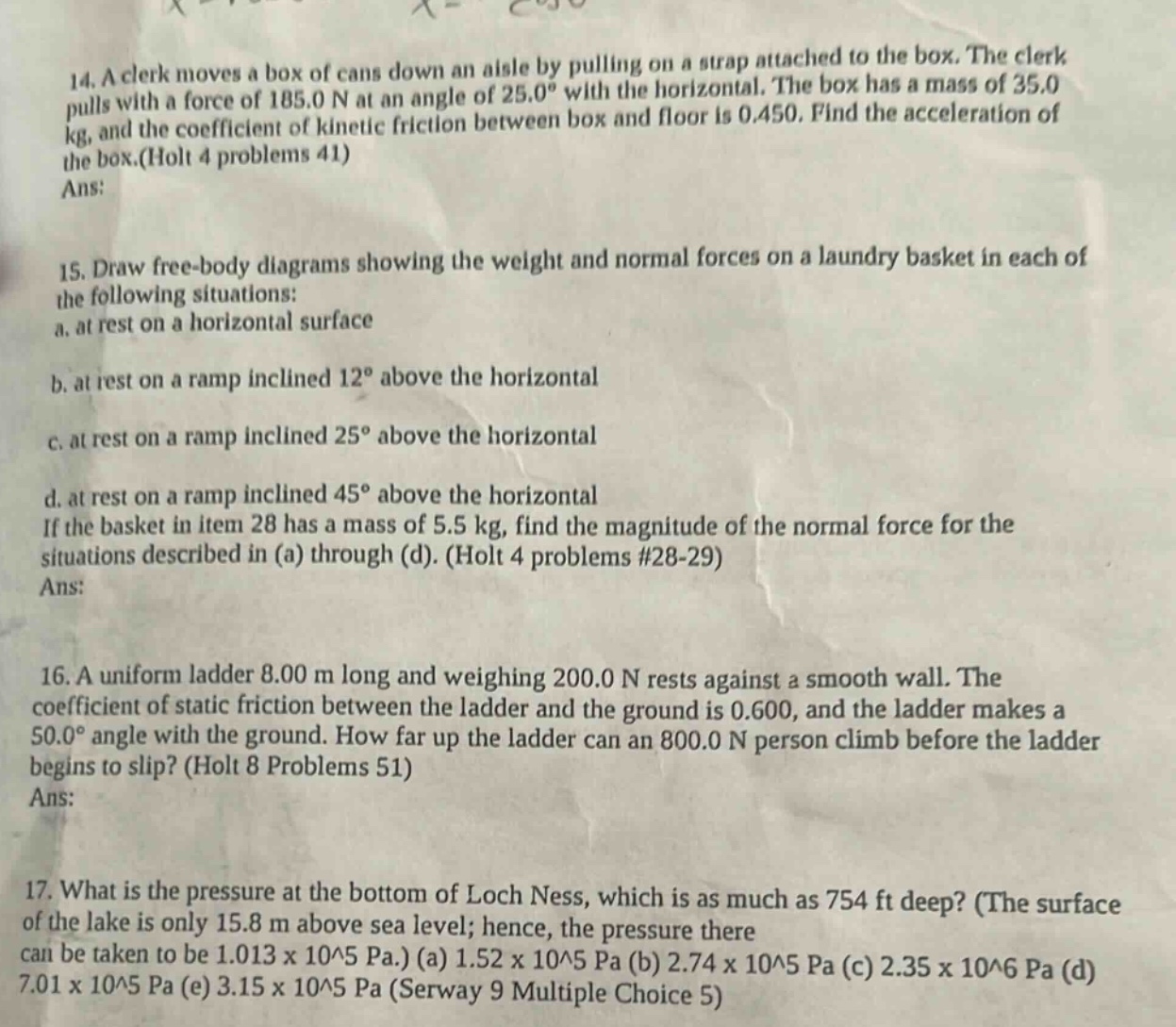
14. a clerk moves a box of cans down an aisle by pulling on a strap attached to the box. the clerk pulls with a force of 185.0 n at an angle of 25.0° with the horizontal. the box has a mass of 35.0 kg, and the coefficient of kinetic friction between box and floor is 0.450. find the acceleration of the box.(holt 4 problems 41)\nans:\n\n15. draw free - body diagrams showing the weight and normal forces on a laundry basket in each of the following situations:\na. at rest on a horizontal surface\nb. at rest on a ramp inclined 12° above the horizontal\nc. at rest on a ramp inclined 25° above the horizontal\nd. at rest on a ramp inclined 45° above the horizontal\nif the basket in item 28 has a mass of 5.5 kg, find the magnitude of the normal force for the situations described in (a) through (d). (holt 4 problems #28 - 29)\nans:\n\n16. a uniform ladder 8.00 m long and weighing 200.0 n rests against a smooth wall. the coefficient of static friction between the ladder and the ground is 0.600, and the ladder makes a 50.0° angle with the ground. how far up the ladder can an 800.0 n person climb before the ladder begins to slip? (holt 8 problems 51)\nans:\n\n17. what is the pressure at the bottom of loch ness, which is as much as 754 ft deep? (the surface of the lake is only 15.8 m above sea level; hence, the pressure there can be taken to be 1.013 x 10^5 pa.) (a) 1.52 x 10^5 pa (b) 2.74 x 10^5 pa (c) 2.35 x 10^6 pa (d) 7.01 x 10^5 pa (e) 3.15 x 10^5 pa (serway 9 multiple choice 5)
Answer
Explanation:
Step1: Analyze forces on the box in x - direction
The net force in the x - direction is $F_{net,x}=F\cos\theta - f$, where $F = 185.0$ N is the applied force, $\theta = 25.0^{\circ}$, and $f=\mu_kN$ is the kinetic - friction force. According to Newton's second law $F_{net,x}=ma_x$.
Step2: Analyze forces on the box in y - direction
The net force in the y - direction is $F_{net,y}=N + F\sin\theta-mg = 0$, so $N=mg - F\sin\theta$. Given $m = 35.0$ kg, $g = 9.8$ m/s², $F = 185.0$ N, and $\theta = 25.0^{\circ}$, we have $N=35.0\times9.8-185.0\times\sin25.0^{\circ}$. [ \begin{align*} N&=35.0\times9.8 - 185.0\times0.4226\ &=343-78.281\ &=264.719\text{ N} \end{align*} ]
Step3: Calculate the friction force
The kinetic - friction force $f=\mu_kN$, with $\mu_k = 0.450$ and $N = 264.719$ N. So $f=0.450\times264.719 = 119.12355$ N.
Step4: Calculate the acceleration in x - direction
The horizontal component of the applied force is $F_x=F\cos\theta=185.0\times\cos25.0^{\circ}=185.0\times0.9063 = 167.6655$ N. Using $F_{net,x}=ma_x$, we have $a_x=\frac{F\cos\theta-\mu_k(mg - F\sin\theta)}{m}$. [ \begin{align*} a_x&=\frac{185.0\times\cos25.0^{\circ}-0.450\times(35.0\times9.8 - 185.0\times\sin25.0^{\circ})}{35.0}\ &=\frac{167.6655-119.12355}{35.0}\ &=\frac{48.54195}{35.0}\ &\approx1.39\text{ m/s}^2 \end{align*} ]
Answer:
$a\approx1.39$ m/s²
Explanation for question 15:
a. At rest on a horizontal surface
The weight $W = mg$ acts vertically downwards and the normal force $N$ acts vertically upwards. Since the basket is at rest, $N = mg$.
b. At rest on a ramp inclined $12^{\circ}$ above the horizontal
Resolve the weight vector into components. The normal force $N$ is perpendicular to the surface of the ramp. $N = mg\cos12^{\circ}$.
c. At rest on a ramp inclined $25^{\circ}$ above the horizontal
The normal force $N = mg\cos25^{\circ}$.
d. At rest on a ramp inclined $45^{\circ}$ above the horizontal
The normal force $N = mg\cos45^{\circ}$. If $m = 5.5$ kg:
- For a: $N=mg=5.5\times9.8 = 53.9$ N
- For b: $N = 5.5\times9.8\times\cos12^{\circ}=5.5\times9.8\times0.9781\approx52.7$ N
- For c: $N = 5.5\times9.8\times\cos25^{\circ}=5.5\times9.8\times0.9063\approx48.8$ N
- For d: $N = 5.5\times9.8\times\cos45^{\circ}=5.5\times9.8\times\frac{\sqrt{2}}{2}\approx38.2$ N
Answer for question 15:
a. The free - body diagram has a downward arrow representing $W = mg$ and an upward arrow representing $N = mg$. Magnitude of $N = 53.9$ N. b. The free - body diagram has a weight vector resolved into components. The normal force arrow is perpendicular to the ramp. Magnitude of $N\approx52.7$ N. c. The free - body diagram has a weight vector resolved into components. The normal force arrow is perpendicular to the ramp. Magnitude of $N\approx48.8$ N. d. The free - body diagram has a weight vector resolved into components. The normal force arrow is perpendicular to the ramp. Magnitude of $N\approx38.2$ N.
Explanation for question 16:
- Identify the forces and torques:
- Let the length of the ladder be $L = 8.00$ m, the weight of the ladder be $W_l=200.0$ N, the weight of the person be $W_p = 800.0$ N, the coefficient of static friction be $\mu_s=0.600$, and the angle between the ladder and the ground be $\theta = 50.0^{\circ}$.
- The normal force at the ground is $N_1$ and at the wall is $N_2$. The frictional force at the ground is $f=\mu_sN_1$.
- Take the torque about the bottom of the ladder. The weight of the ladder acts at its mid - point, $L/2$. Let the distance the person climbs up the ladder be $x$.
- The sum of the torques about the bottom of the ladder $\sum\tau = 0$. The normal force $N_2$ creates a clock - wise torque, and the weights of the ladder and the person create counter - clockwise torques. $\sum\tau=N_2L\sin\theta - W_l\frac{L}{2}\cos\theta - W_px\cos\theta = 0$.
- In the horizontal direction, $f = N_2$ and in the vertical direction, $N_1=W_l + W_p$.
- Find $N_1$:
- $N_1=200.0 + 800.0=1000$ N.
- Find $N_2$:
- Since $f=\mu_sN_1$ and $f = N_2$, $N_2=\mu_sN_1=0.600\times1000 = 600$ N.
- Solve for $x$:
- From $\sum\tau = 0$, we have $N_2L\sin\theta - W_l\frac{L}{2}\cos\theta - W_px\cos\theta = 0$.
- Rearranging for $x$ gives $x=\frac{N_2L\sin\theta - W_l\frac{L}{2}\cos\theta}{W_p\cos\theta}$.
- Substitute the values: [ \begin{align*} x&=\frac{600\times8.00\times\sin50.0^{\circ}-200.0\times\frac{8.00}{2}\times\cos50.0^{\circ}}{800.0\times\cos50.0^{\circ}}\ &=\frac{600\times8.00\times0.766 - 200.0\times4.00\times0.643}{800.0\times0.643}\ &=\frac{3676.8-514.4}{514.4}\ &=\frac{3162.4}{514.4}\ &\approx6.15\text{ m} \end{align*} ]
Answer for question 16:
$x\approx6.15$ m
Explanation for question 17:
- Convert the depth to SI units:
- The depth $h = 754$ ft. Since $1$ ft $= 0.3048$ m, $h = 754\times0.3048=230$ m.
- Use the hydro - static pressure formula:
- The pressure at a depth $h$ in a fluid is $P = P_0+\rho gh$, where $P_0 = 1.013\times10^5$ Pa is the atmospheric pressure at the surface, $\rho = 1000$ kg/m³ is the density of water, and $g = 9.8$ m/s².
- $P=1.013\times10^5+1000\times9.8\times230$. [ \begin{align*} P&=1.013\times10^5 + 2.254\times10^6\ &=2.3553\times10^6\text{ Pa}\approx2.35\times10^6\text{ Pa} \end{align*} ]
Answer for question 17:
c. $2.35\times10^6$ Pa