15c section review\n1. when light photons are considered to be particles, what kind of path do they usually…
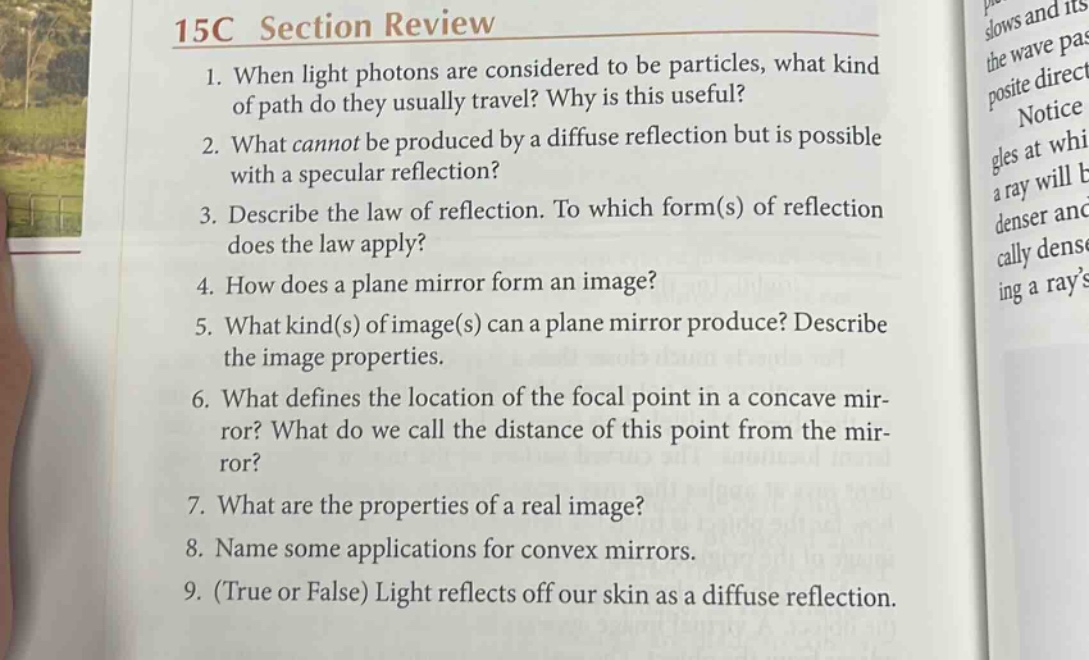
15c section review\n1. when light photons are considered to be particles, what kind of path do they usually travel? why is this useful?\n2. what cannot be produced by a diffuse reflection but is possible with a specular reflection?\n3. describe the law of reflection. to which form(s) of reflection does the law apply?\n4. how does a plane mirror form an image?\n5. what kind(s) of image(s) can a plane mirror produce? describe the image properties.\n6. what defines the location of the focal point in a concave mirror? what do we call the distance of this point from the mirror?\n7. what are the properties of a real image?\n8. name some applications for convex mirrors.\n9. (true or false) light reflects off our skin as a diffuse reflection.
Answer
Brief Explanations:
- When considered as particles, light photons travel in straight - line paths (rectilinear propagation). This is useful for applications like pin - hole cameras and understanding shadow formation.
- A clear, well - defined image cannot be produced by diffuse reflection but is possible with specular reflection. Diffuse reflection scatters light in many directions, while specular reflection reflects light in a single, predictable direction.
- The law of reflection states that the angle of incidence is equal to the angle of reflection ($\theta_i=\theta_r$), and the incident ray, reflected ray, and the normal to the surface all lie in the same plane. This law applies to both specular and diffuse reflection at a microscopic level.
- A plane mirror forms an image by reflecting light rays. The image is formed behind the mirror at a distance equal to the object's distance from the mirror. The light rays that reach our eyes appear to come from this virtual image location.
- A plane mirror produces a virtual image. The image has the following properties: it is upright, has the same size as the object, and is laterally inverted.
- In a concave mirror, the focal point is defined as the point where parallel rays of light (parallel to the principal axis) converge after reflection. The distance of this point from the mirror is called the focal length.
- Properties of a real image: It can be projected onto a screen, is inverted (usually), and light actually passes through the image location.
- Applications of convex mirrors include side - view mirrors on vehicles (provide a wide field of view), security mirrors in stores (allow for a large area to be monitored).
- True. Our skin has a rough surface on a microscopic level, so light reflects off it as a diffuse reflection.
Answer:
- Straight - line paths; useful for pin - hole cameras and shadow formation.
- A clear, well - defined image.
- $\theta_i=\theta_r$, incident, reflected rays and normal lie in same plane; applies to both specular and diffuse (microscopically).
- By reflecting light rays, image formed behind mirror at equal distance.
- Virtual image; upright, same size, laterally inverted.
- Point where parallel rays converge; focal length.
- Can be projected, usually inverted, light passes through.
- Vehicle side - view mirrors, store security mirrors.
- True.