20. in recent scientific history, the classification of protists has changed several times. they now have…
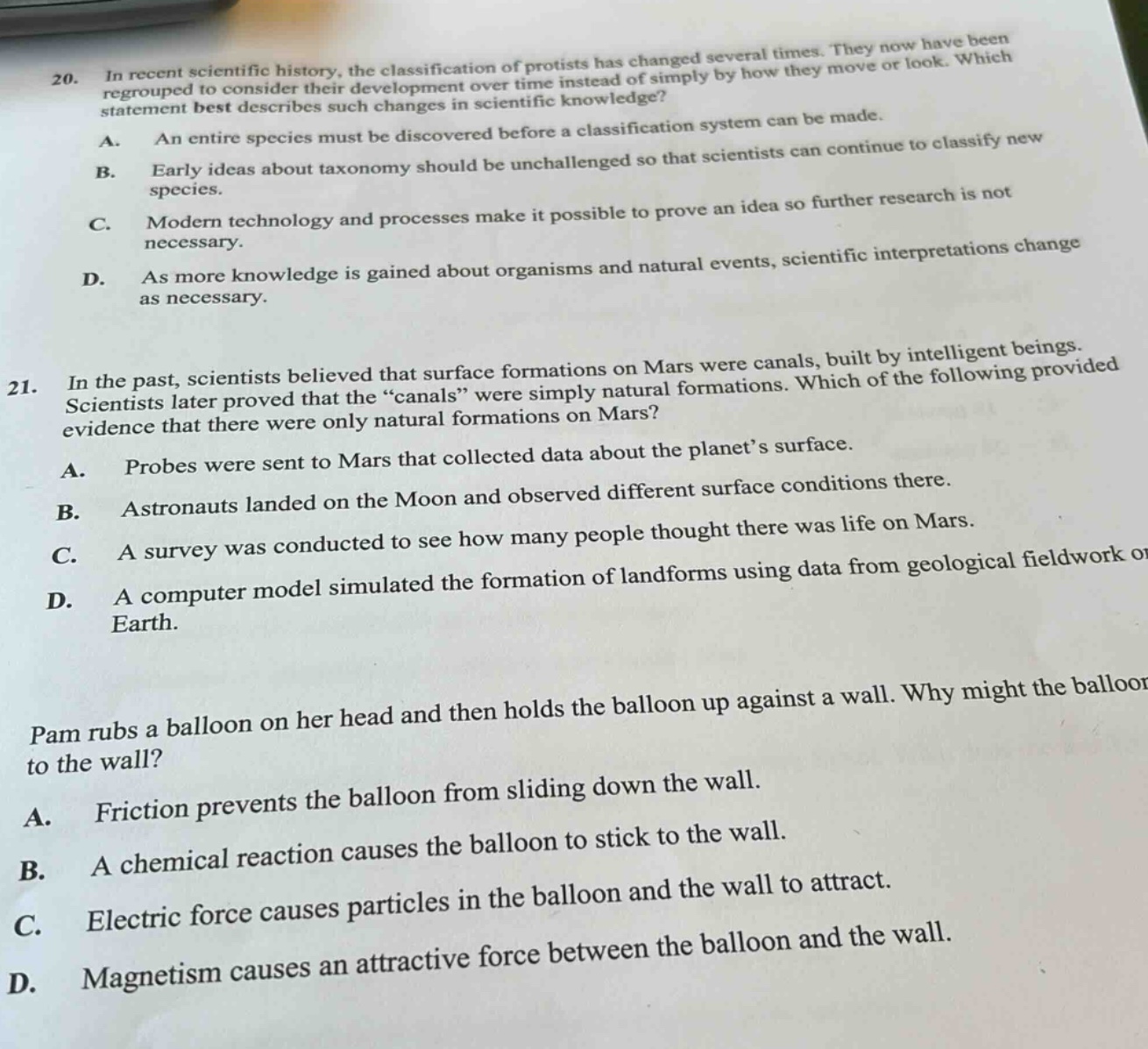
20. in recent scientific history, the classification of protists has changed several times. they now have been regrouped to consider their development over time instead of simply by how they move or look. which statement best describes such changes in scientific knowledge? a. an entire species must be discovered before a classification system can be made. b. early ideas about taxonomy should be unchallenged so that scientists can continue to classify new species. c. modern technology and processes make it possible to prove an idea so further research is not necessary. d. as more knowledge is gained about organisms and natural events, scientific interpretations change as necessary. 21. in the past, scientists believed that surface formations on mars were canals, built by intelligent beings. scientists later proved that the “canals” were simply natural formations. which of the following provided evidence that there were only natural formations on mars? a. probes were sent to mars that collected data about the planet’s surface. b. astronauts landed on the moon and observed different surface conditions there. c. a survey was conducted to see how many people thought there was life on mars. d. a computer model simulated the formation of landforms using data from geological fieldwork on earth. pam rubs a balloon on her head and then holds the balloon up against a wall. why might the balloon stick to the wall? a. friction prevents the balloon from sliding down the wall. b. a chemical reaction causes the balloon to stick to the wall. c. electric force causes particles in the balloon and the wall to attract. d. magnetism causes an attractive force between the balloon and the wall.
Answer
Brief Explanations:
Question 20:
As knowledge about organisms evolves, scientific interpretations adapt. This is a common aspect of scientific progress.
Question 21:
Sending probes to Mars allows for direct - data collection about its surface, providing evidence about its formations.
Question 22:
When a balloon is rubbed on hair, it becomes charged. The electric force between the charged balloon and the wall causes the balloon to stick.