a 225 kg red bumper car is moving at 3.0 m/s. it hits a stationary 180 kg blue bumper car. the red and blue…
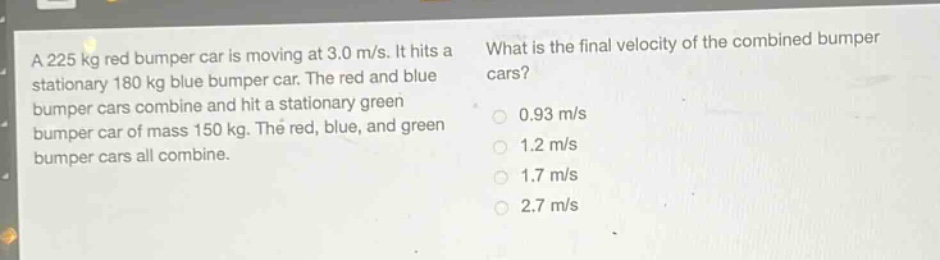
a 225 kg red bumper car is moving at 3.0 m/s. it hits a stationary 180 kg blue bumper car. the red and blue bumper cars combine and hit a stationary green bumper car of mass 150 kg. the red, blue, and green bumper cars all combine. what is the final velocity of the combined bumper cars? 0.93 m/s 1.2 m/s 1.7 m/s 2.7 m/s
Answer
Explanation:
Step1: Apply conservation of momentum
The initial momentum of the system is just the momentum of the red bumper - car since the blue and green ones are stationary. The formula for momentum is $p = mv$. The initial momentum $p_i$ of the red car is $p_i=m_{red}v_{red}$, where $m_{red}=225\ kg$ and $v_{red}=3.0\ m/s$. So $p_i = 225\times3=675\ kg\cdot m/s$.
Step2: Calculate the total mass of the combined cars
The total mass $m_{total}$ of the combined red, blue, and green bumper - cars is $m_{total}=m_{red}+m_{blue}+m_{green}$, with $m_{red}=225\ kg$, $m_{blue}=180\ kg$, and $m_{green}=150\ kg$. So $m_{total}=225 + 180+150=555\ kg$.
Step3: Use conservation of momentum to find final velocity
According to the law of conservation of momentum $p_i = p_f$, and $p_f=m_{total}v_f$. We know $p_i = 675\ kg\cdot m/s$ and $m_{total}=555\ kg$. Then $v_f=\frac{p_i}{m_{total}}=\frac{675}{555}\approx1.2\ m/s$.
Answer:
1.2 m/s