23. list five disadvantages of bubbler level detection systems. (5 points)\n24. in a magnetic flowmeter, the…
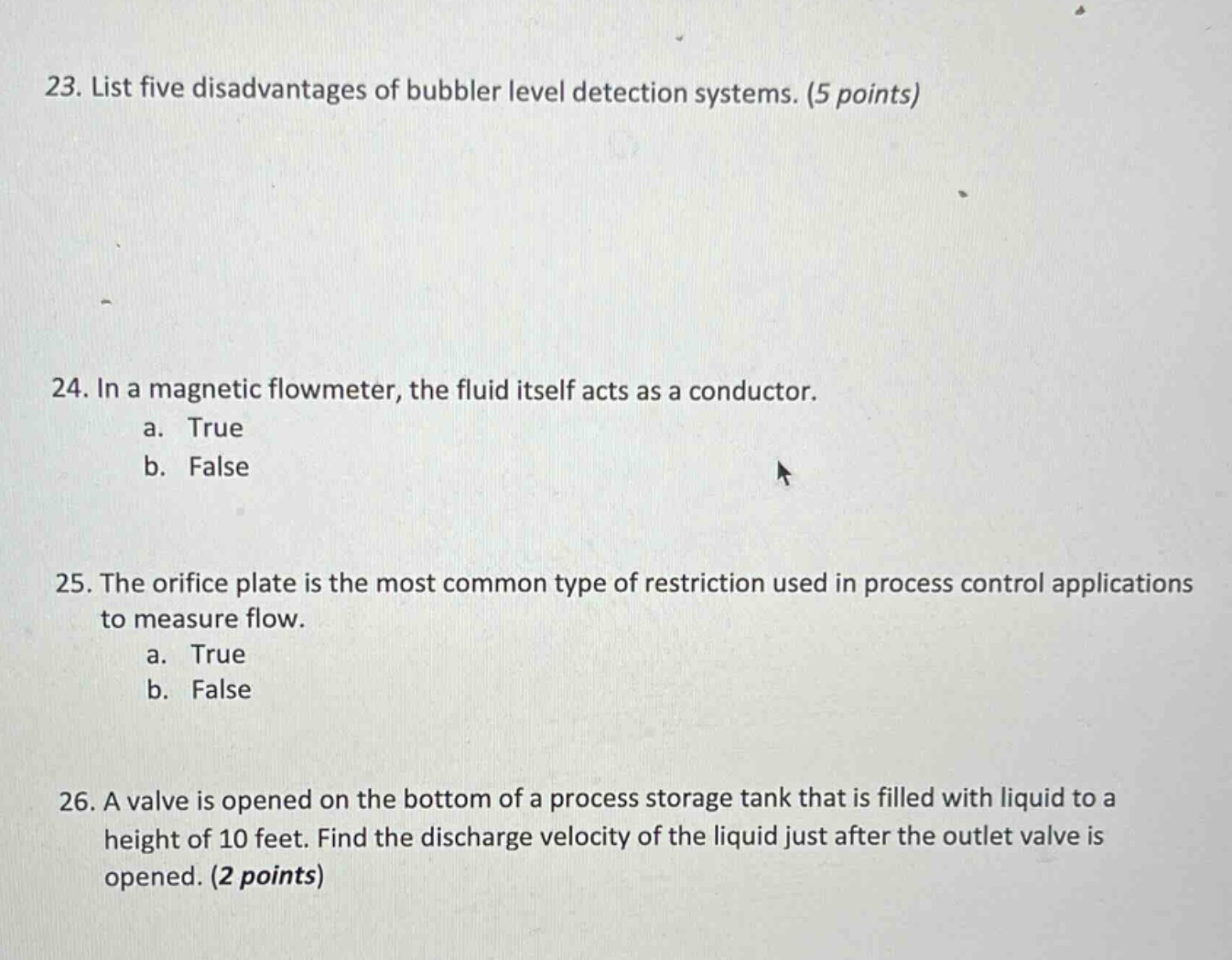
23. list five disadvantages of bubbler level detection systems. (5 points)\n24. in a magnetic flowmeter, the fluid itself acts as a conductor.\na. true\nb. false\n25. the orifice plate is the most common type of restriction used in process control applications to measure flow.\na. true\nb. false\n26. a valve is opened on the bottom of a process storage tank that is filled with liquid to a height of 10 feet. find the discharge velocity of the liquid just after the outlet valve is opened. (2 points)
Answer
Explanation:
Step1: Apply Torricelli's Law
Torricelli's Law states that the velocity (v) of a fluid flowing out of an orifice is given by (v = \sqrt{2gh}), where (g) is the acceleration due to gravity ((g = 32.2\space ft/s^{2})) and (h) is the height of the fluid above the orifice.
Step2: Substitute the values
We are given (h = 10\space ft) and (g=32.2\space ft/s^{2}). Substitute these values into the formula: [ \begin{align*} v&=\sqrt{2\times32.2\times10}\ &=\sqrt{644}\ &\approx 25.4\space ft/s \end{align*} ]
Answer:
The discharge velocity of the liquid is approximately (25.4\space ft/s)