2. (25 pts, 6 pts b, c and d) a m = 20 - kg block on a horizontal surface is attached to a light spring…
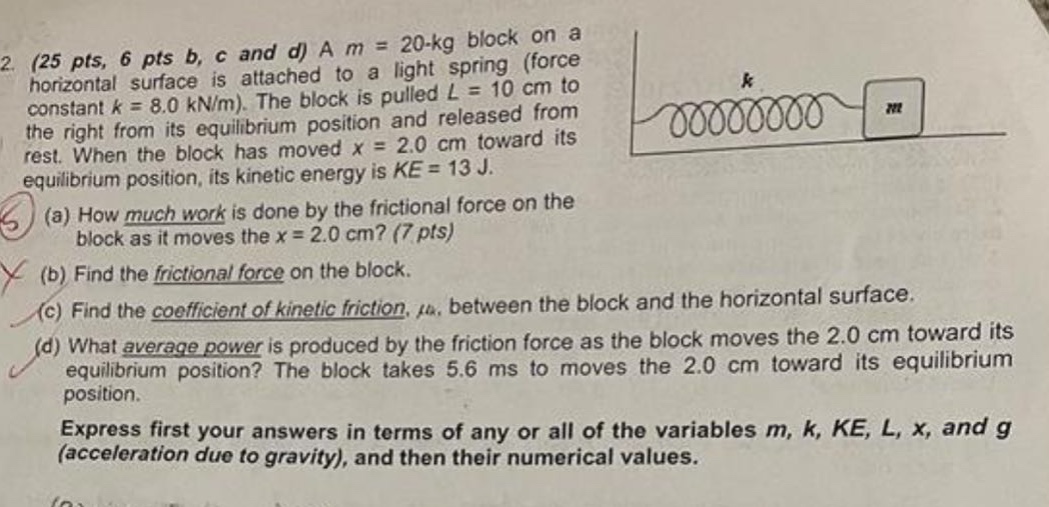
2. (25 pts, 6 pts b, c and d) a m = 20 - kg block on a horizontal surface is attached to a light spring (force constant k = 8.0 kn/m). the block is pulled l = 10 cm to the right from its equilibrium position and released from rest. when the block has moved x = 2.0 cm toward its equilibrium position, its kinetic energy is ke = 13 j. (a) how much work is done by the frictional force on the block as it moves the x = 2.0 cm? (7 pts) (b) find the frictional force on the block. (c) find the coefficient of kinetic friction, μk, between the block and the horizontal surface. (d) what average power is produced by the friction force as the block moves the 2.0 cm toward its equilibrium position? the block takes 5.6 ms to moves the 2.0 cm toward its equilibrium position. express first your answers in terms of any or all of the variables m, k, ke, l, x, and g (acceleration due to gravity), and then their numerical values.
Answer
Explanation:
Step1: Calculate initial elastic - potential energy
The formula for elastic - potential energy is $U_{i}=\frac{1}{2}kL^{2}$. Given $k = 8.0\times10^{3}\ N/m$ and $L=0.1\ m$, so $U_{i}=\frac{1}{2}\times8.0\times 10^{3}\times(0.1)^{2}=40\ J$.
Step2: Calculate final elastic - potential energy
The formula for elastic - potential energy at position $x$ is $U_{f}=\frac{1}{2}kx^{2}$. Given $k = 8.0\times10^{3}\ N/m$ and $x = 0.02\ m$, so $U_{f}=\frac{1}{2}\times8.0\times 10^{3}\times(0.02)^{2}=1.6\ J$.
Step3: Use work - energy theorem for part (a)
The work - energy theorem states that $W_{nc}=K_{f}+U_{f}-(K_{i}+U_{i})$. Initially, $K_{i}=0$. We know $K_{f}=13\ J$, $U_{i}=40\ J$ and $U_{f}=1.6\ J$. So $W_{friction}=13 + 1.6-40=-25.4\ J$.
Step4: Calculate frictional force for part (b)
The work done by friction is $W_{friction}=-F_{f}d$. Here $d = x=0.02\ m$ and $W_{friction}=- 25.4\ J$. So $F_{f}=\frac{-W_{friction}}{x}=\frac{25.4}{0.02}=1270\ N$.
Step5: Calculate coefficient of kinetic friction for part (c)
The normal force $N = mg$, where $m = 20\ kg$ and $g = 9.8\ m/s^{2}$, so $N=20\times9.8 = 196\ N$. Since $F_{f}=\mu_{k}N$, then $\mu_{k}=\frac{F_{f}}{N}=\frac{1270}{196}\approx6.48$.
Step6: Calculate average power for part (d)
The formula for average power is $P=\frac{|W_{friction}|}{t}$. Given $W_{friction}=-25.4\ J$ and $t = 5.6\times10^{-3}\ s$. So $P=\frac{25.4}{5.6\times10^{-3}}\approx4535.71\ W$.
Answer:
(a) In terms of variables: $W_{friction}=KE+\frac{1}{2}kx^{2}-\frac{1}{2}kL^{2}$, Numerical value: $-25.4\ J$ (b) In terms of variables: $F_{f}=\frac{\frac{1}{2}kL^{2}-\frac{1}{2}kx^{2}-KE}{x}$, Numerical value: $1270\ N$ (c) In terms of variables: $\mu_{k}=\frac{\frac{1}{2}kL^{2}-\frac{1}{2}kx^{2}-KE}{mgx}$, Numerical value: $\approx6.48$ (d) In terms of variables: $P=\frac{\left|\frac{1}{2}kL^{2}-\frac{1}{2}kx^{2}-KE\right|}{t}$, Numerical value: $\approx4535.71\ W$