a 5.25 g sample of metal gives off 10.4 j of energy as it cools from 49.5 °c to 40.5 °c. what is the…
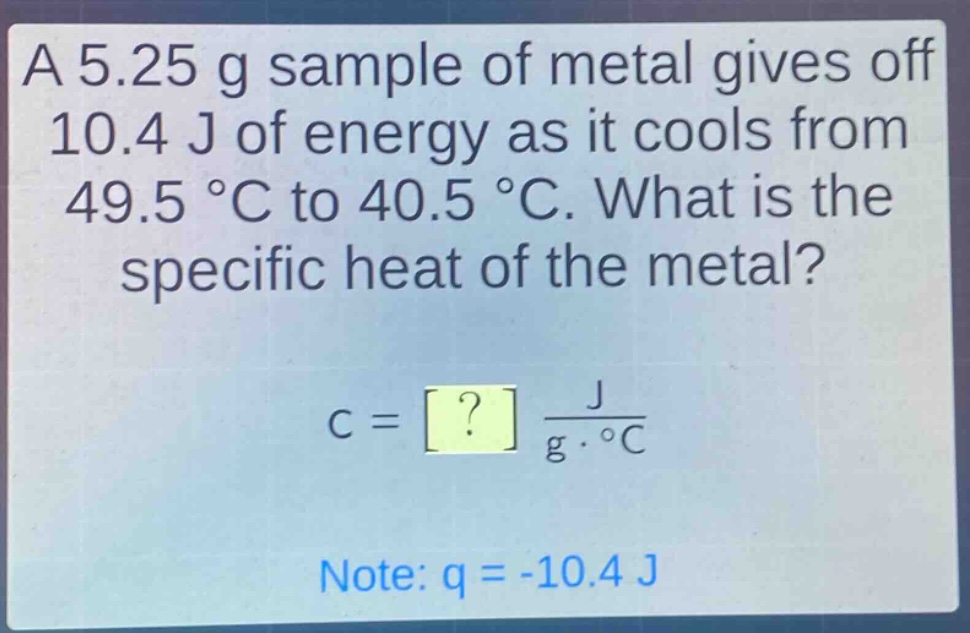
a 5.25 g sample of metal gives off 10.4 j of energy as it cools from 49.5 °c to 40.5 °c. what is the specific heat of the metal?\n\nc = ? $\frac{j}{gcdot^{circ}c}$\n\nnote: q = -10.4 j
Answer
Explanation:
Step1: Identify the formula
The formula for heat transfer is $q = mc\Delta T$, where $q$ is the heat energy, $m$ is the mass, $c$ is the specific - heat capacity, and $\Delta T$ is the change in temperature. We need to solve for $c$, so we can re - arrange the formula to $c=\frac{q}{m\Delta T}$.
Step2: Calculate the change in temperature
$\Delta T=T_{final}-T_{initial}=40.5^{\circ}C - 49.5^{\circ}C=-9.0^{\circ}C$.
Step3: Substitute the values into the formula
We know that $q = - 10.4\ J$, $m = 5.25\ g$, and $\Delta T=-9.0^{\circ}C$. Substituting these values into $c=\frac{q}{m\Delta T}$, we get $c=\frac{-10.4\ J}{5.25\ g\times(-9.0^{\circ}C)}$.
Step4: Calculate the specific heat
$c=\frac{-10.4\ J}{-47.25\ g\cdot^{\circ}C}\approx0.22\ \frac{J}{g\cdot^{\circ}C}$.
Answer:
$0.22\ \frac{J}{g\cdot^{\circ}C}$