28. in a symbiotic relationship where both organisms benefit, its called ______________\n29. give an example…
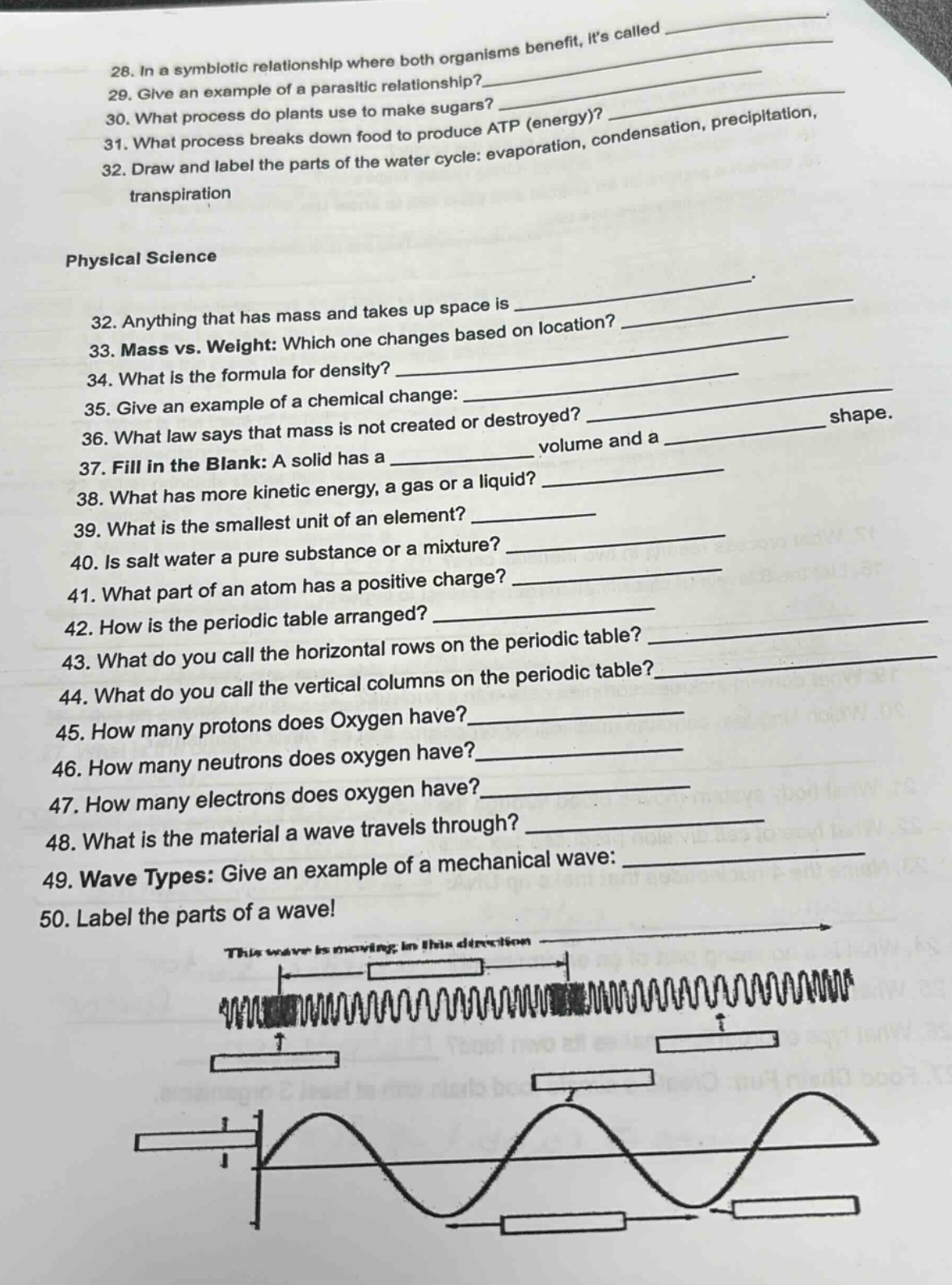
28. in a symbiotic relationship where both organisms benefit, its called ______________\n29. give an example of a parasitic relationship? ______________\n30. what process do plants use to make sugars? ______________\n31. what process breaks down food to produce atp (energy)? ______________\n32. draw and label the parts of the water - cycle: evaporation, condensation, precipitation, transpiration\n\nphysical science\n32. anything that has mass and takes up space is ______________\n33. mass vs. weight: which one changes based on location? ______________\n34. what is the formula for density? ______________\n35. give an example of a chemical change: ______________\n36. what law says that mass is not created or destroyed? ______________\n37. fill in the blank: a solid has a ______________ volume and a ______________ shape.\n38. what has more kinetic energy, a gas or a liquid? ______________\n39. what is the smallest unit of an element? ______________\n40. is salt water a pure substance or a mixture? ______________\n41. what part of an atom has a positive charge? ______________\n42. how is the periodic table arranged? ______________\n43. what do you call the horizontal rows on the periodic table? ______________\n44. what do you call the vertical columns on the periodic table? ______________\n45. how many protons does oxygen have? ______________\n46. how many neutrons does oxygen have? ______________\n47. how many electrons does oxygen have? ______________\n48. what is the material a wave travels through? ______________\n49. wave types: give an example of a mechanical wave: ______________\n50. label the parts of a wave!
Answer
Brief Explanations:
- In symbiotic relationships, mutualism is when both organisms benefit.
- A tick on a dog is a parasitic relationship example.
- Plants use photosynthesis to make sugars.
- Cellular respiration breaks down food for ATP.
- The water - cycle involves evaporation (liquid to gas), condensation (gas to liquid), precipitation (rain, snow etc.), and transpiration (plants releasing water vapor).
- Weight changes based on location due to gravity differences, while mass is constant.
- The density formula is $\rho=\frac{m}{V}$, where $\rho$ is density, $m$ is mass, and $V$ is volume.
- Burning wood is a chemical change as new substances are formed.
- The law of conservation of mass states mass is not created or destroyed.
- A solid has a definite volume and a definite shape.
- A gas has more kinetic energy as its particles move more freely than in a liquid.
- The smallest unit of an element is an atom.
- Salt water is a mixture as it contains salt and water which can be separated physically.
- Protons in an atom have a positive charge.
- The periodic table is arranged by increasing atomic number.
- Horizontal rows on the periodic table are called periods.
- Vertical columns on the periodic table are called groups or families.
- Oxygen has 8 protons.
- Most common oxygen - 16 has 8 neutrons.
- In a neutral oxygen atom, there are 8 electrons.
- The material a wave travels through is called the medium.
- A sound wave is an example of a mechanical wave.
- Parts of a wave include crest (highest point), trough (lowest point), wavelength (distance between two identical points), amplitude (height from rest to crest or trough).
Answer:
- Mutualism
- A tick on a dog
- Photosynthesis
- Cellular respiration
- Evaporation: Liquid water turns to water vapor. Condensation: Water vapor turns to liquid droplets. Precipitation: Water falls as rain, snow, etc. Transpiration: Plants release water vapor.
- Weight
- $\rho = \frac{m}{V}$
- Burning wood
- Law of conservation of mass
- Definite; definite
- Gas
- Atom
- Mixture
- Proton
- By increasing atomic number
- Periods
- Groups or families
- 8
- 8 (for oxygen - 16)
- 8
- Medium
- Sound wave
- Crest, trough, wavelength, amplitude