a 30.0 kg object has an initial velocity of 7.00 m/s and a final velocity of 10.0 m/s. the work done on the…
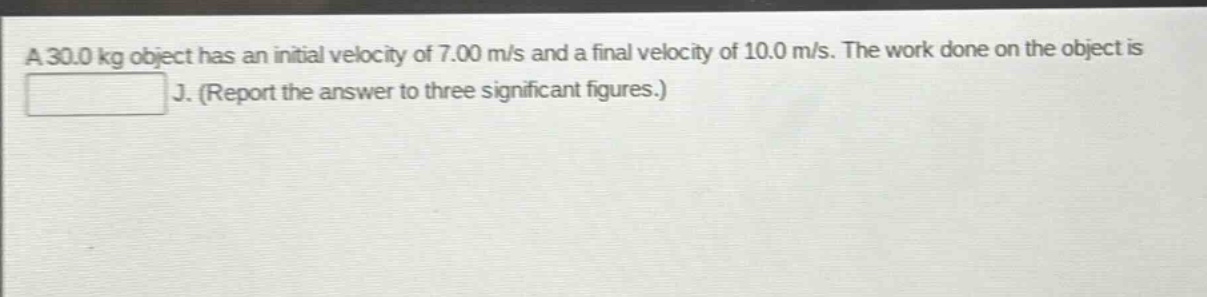
a 30.0 kg object has an initial velocity of 7.00 m/s and a final velocity of 10.0 m/s. the work done on the object is j. (report the answer to three significant figures.)
Answer
Explanation:
Step1: Recall work - energy theorem
The work - energy theorem states that the work done on an object $W$ is equal to the change in its kinetic energy $\Delta K$. The formula for kinetic energy is $K=\frac{1}{2}mv^{2}$, so $W = K_f - K_i=\frac{1}{2}mv_f^{2}-\frac{1}{2}mv_i^{2}$, where $m$ is the mass of the object, $v_i$ is the initial velocity, and $v_f$ is the final velocity.
Step2: Identify given values
We are given that $m = 30.0\ kg$, $v_i=7.00\ m/s$, and $v_f = 10.0\ m/s$.
Step3: Calculate the work done
Substitute the values into the formula: [ \begin{align*} W&=\frac{1}{2}m(v_f^{2}-v_i^{2})\ &=\frac{1}{2}\times30.0\times(10.0^{2}-7.00^{2})\ & = 15\times(100 - 49)\ &=15\times51\ & = 765 \end{align*} ]
Answer:
765