a 30.0 kg object has an initial velocity of 7.00 m/s and a final velocity of 10.0 m/s. the work done on the…
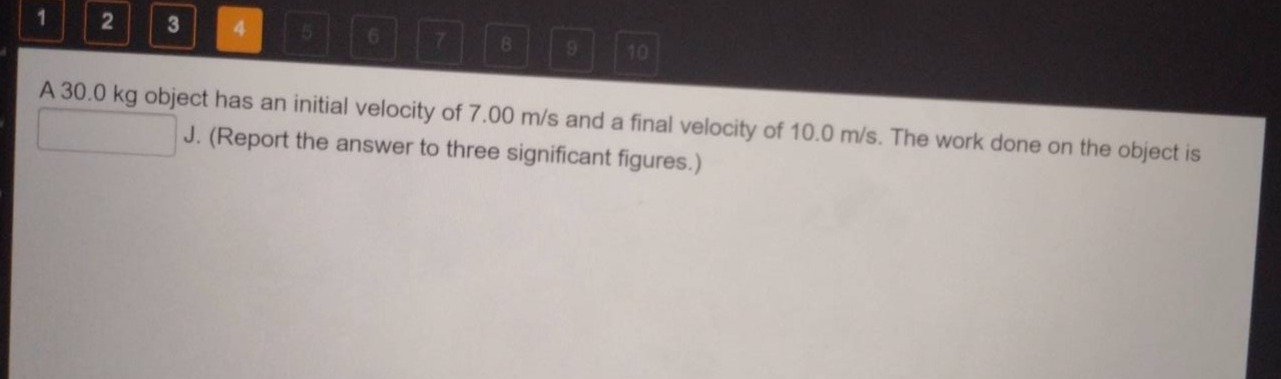
a 30.0 kg object has an initial velocity of 7.00 m/s and a final velocity of 10.0 m/s. the work done on the object is j. (report the answer to three significant figures.)
Answer
Answer:
$645$
Explanation:
Step1: Recall work - energy theorem
Work done $W=\Delta K = K_f - K_i$
Step2: Calculate initial kinetic energy
$K_i=\frac{1}{2}mv_i^2$, where $m = 30.0\ kg$ and $v_i=7.00\ m/s$. So $K_i=\frac{1}{2}\times30.0\times(7.00)^2=\frac{1}{2}\times30.0\times49.0 = 735\ J$
Step3: Calculate final kinetic energy
$K_f=\frac{1}{2}mv_f^2$, where $m = 30.0\ kg$ and $v_f = 10.0\ m/s$. So $K_f=\frac{1}{2}\times30.0\times(10.0)^2=\frac{1}{2}\times30.0\times100=1500\ J$
Step4: Calculate work done
$W=K_f - K_i=1500 - 735=765\ J$