4.39 obtain the thevenin equivalent at terminals a - b of the circuit shown in fig. 4.106.
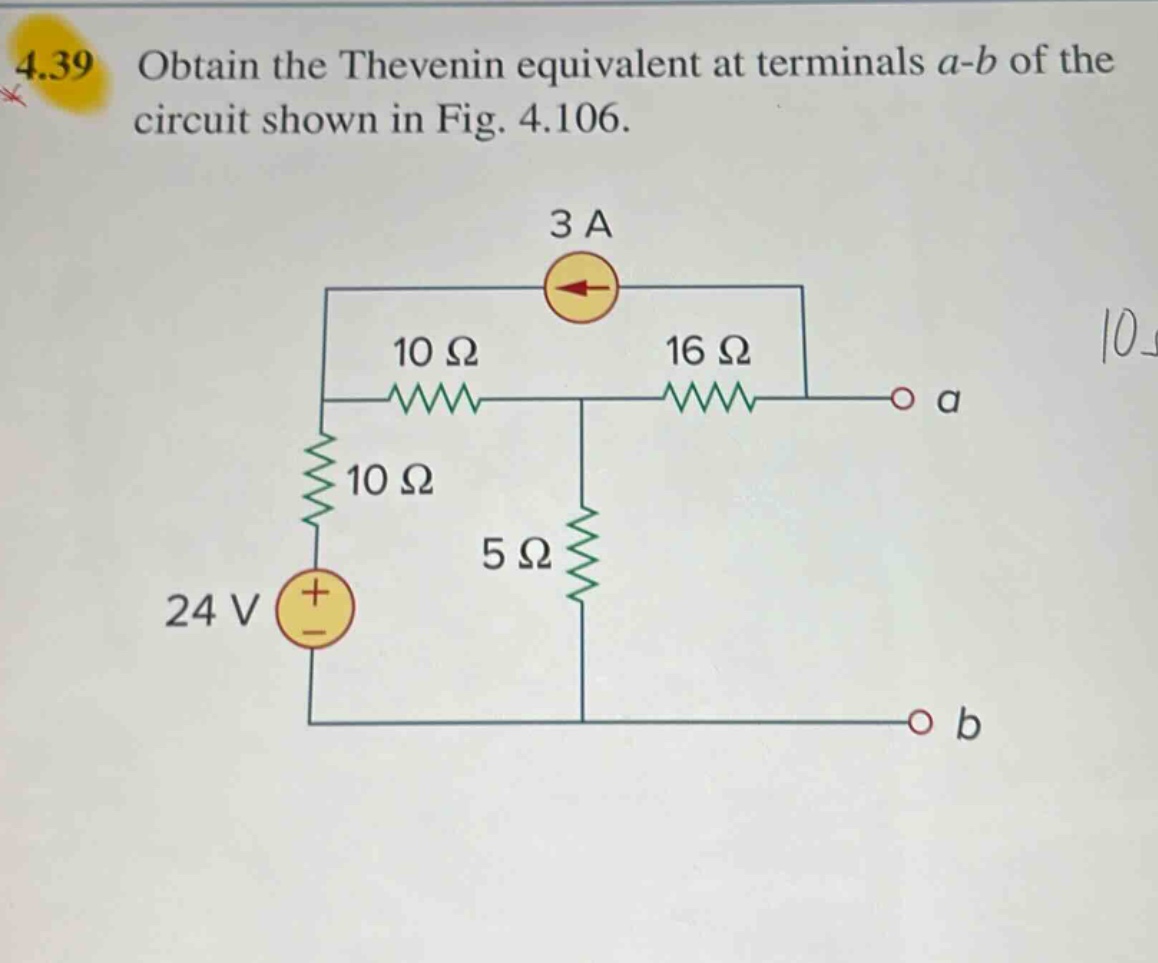
4.39 obtain the thevenin equivalent at terminals a - b of the circuit shown in fig. 4.106.
Answer
Explanation:
Step1: Find $V_{Th}$ (open - circuit voltage)
Let's use nodal analysis. Let the bottom - node be the reference node. Let the node between the two $10\Omega$ resistors be $V_1$ and the node between the $5\Omega$ and $16\Omega$ resistors be $V_{Th}$. For the node $V_1$: $\frac{V_1 - 24}{10}+\frac{V_1}{10}+\frac{V_1 - V_{Th}}{5}=0$ For the node $V_{Th}$: $\frac{V_{Th}-V_1}{5}+3-\frac{V_{Th}}{16}=0$ From the first equation: $\frac{V_1 - 24+V_1+(2V_1 - 2V_{Th})}{10}=0$ $4V_1-2V_{Th}=24$ or $2V_1 - V_{Th}=12$ (Equation 1) From the second equation: $16(V_{Th}-V_1)+3\times80 - 5V_{Th}=0$ $16V_{Th}-16V_1 + 240-5V_{Th}=0$ $- 16V_1+11V_{Th}=-240$ (Equation 2) Multiply Equation 1 by 8: $16V_1-8V_{Th}=96$ Add it to Equation 2: $(-16V_1 + 11V_{Th})+(16V_1-8V_{Th})=-240 + 96$ $3V_{Th}=-144$ $V_{Th}=- 48V$
Step2: Find $R_{Th}$ (equivalent resistance)
Set the independent sources to zero. Replace the voltage source with a short - circuit and the current source with an open - circuit. The resistors are arranged such that the two $10\Omega$ resistors are in parallel, and then in series with the parallel combination of $5\Omega$ and $16\Omega$. The equivalent resistance of the two $10\Omega$ resistors in parallel is $R_{10 - 10}=\frac{10\times10}{10 + 10}=5\Omega$ The equivalent resistance of the $5\Omega$ and $16\Omega$ resistors in parallel is $R_{5 - 16}=\frac{5\times16}{5 + 16}=\frac{80}{21}\Omega$ $R_{Th}=5+\frac{80}{21}=\frac{105 + 80}{21}=\frac{185}{21}\Omega\approx8.81\Omega$
The Thevenin equivalent circuit at terminals $a - b$ consists of a voltage source $V_{Th}=-48V$ in series with a resistance $R_{Th}=\frac{185}{21}\Omega$
Answer:
$V_{Th}=-48V$, $R_{Th}=\frac{185}{21}\Omega$