a 440 kg roller coaster car is going 26 m/s when it reaches the lowest point on the track. if the car…
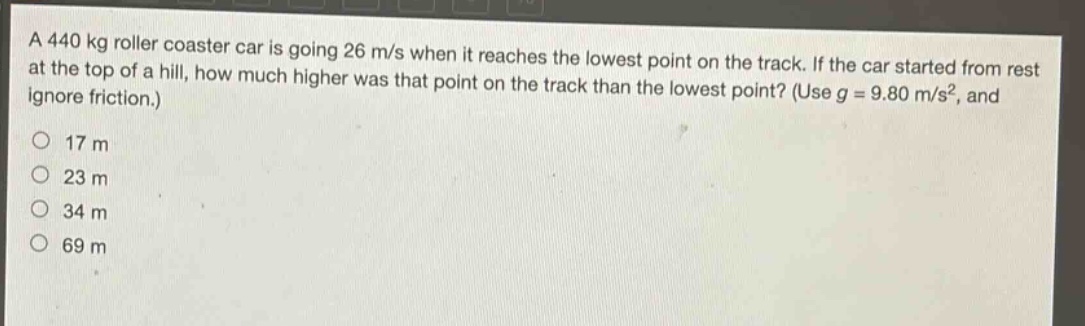
a 440 kg roller coaster car is going 26 m/s when it reaches the lowest point on the track. if the car started from rest at the top of a hill, how much higher was that point on the track than the lowest point? (use g = 9.80 m/s², and ignore friction.)\n17 m\n23 m\n34 m\n69 m
Answer
Explanation:
Step1: Apply conservation of mechanical energy
Initial mechanical - energy $E_1 = mgh$ (potential energy at the top, kinetic energy is 0 as it starts from rest), final mechanical - energy $E_2=\frac{1}{2}mv^{2}$ (potential energy at the lowest point is 0). Since there is no friction, $E_1 = E_2$. $mgh=\frac{1}{2}mv^{2}$
Step2: Solve for height h
We can cancel out the mass m from both sides of the equation $mgh=\frac{1}{2}mv^{2}$. Then we get $h=\frac{v^{2}}{2g}$. Given $v = 26\ m/s$ and $g = 9.80\ m/s^{2}$, substitute these values into the formula: $h=\frac{26^{2}}{2\times9.80}=\frac{676}{19.6}\approx34.5\ m\approx34\ m$.
Answer:
34 m