a 50 g sample of an unknown metal is heated to 90.0°c. it is placed in a perfectly insulated container along…
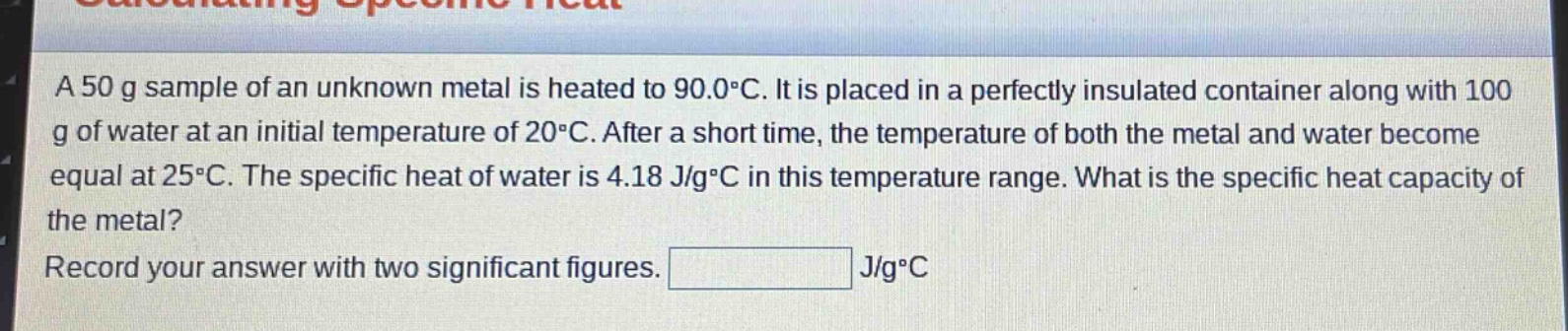
a 50 g sample of an unknown metal is heated to 90.0°c. it is placed in a perfectly insulated container along with 100 g of water at an initial temperature of 20°c. after a short time, the temperature of both the metal and water become equal at 25°c. the specific heat of water is 4.18 j/g°c in this temperature range. what is the specific heat capacity of the metal? record your answer with two significant figures. j/g°c
Answer
Explanation:
Step1: Determine heat lost by metal
The heat lost by the metal $Q_{metal}$ is given by the formula $Q = mc\Delta T$. Let the specific - heat capacity of the metal be $c_{metal}$. The mass of the metal $m_{metal}=50\ g$, the initial temperature of the metal $T_{i - metal}=90.0^{\circ}C$ and the final temperature $T_f = 25^{\circ}C$. So, $\Delta T_{metal}=T_f - T_{i - metal}=25 - 90=- 65^{\circ}C$. Then $Q_{metal}=m_{metal}c_{metal}\Delta T_{metal}=50\times c_{metal}\times(-65)=-3250c_{metal}$.
Step2: Determine heat gained by water
The heat gained by water $Q_{water}$ is given by $Q = mc\Delta T$. The mass of water $m_{water}=100\ g$, the specific - heat capacity of water $c_{water}=4.18\ J/g^{\circ}C$, the initial temperature of water $T_{i - water}=20^{\circ}C$ and the final temperature $T_f = 25^{\circ}C$. So, $\Delta T_{water}=T_f - T_{i - water}=25 - 20 = 5^{\circ}C$. Then $Q_{water}=m_{water}c_{water}\Delta T_{water}=100\times4.18\times5 = 2090\ J$.
Step3: Apply the principle of conservation of energy
In a perfectly insulated container, the heat lost by the metal is equal to the heat gained by the water (i.e., $Q_{metal}=-Q_{water}$). Since $Q_{metal}=-3250c_{metal}$ and $Q_{water}=2090\ J$, we have $-3250c_{metal}=-2090$.
Step4: Solve for the specific - heat capacity of the metal
Dividing both sides of the equation $-3250c_{metal}=-2090$ by $- 3250$, we get $c_{metal}=\frac{2090}{3250}\approx0.64\ J/g^{\circ}C$.
Answer:
$0.64$