a 60.0 kg object is moving east at 8.00 m/s, and then slows down to 4.00 m/s. how much work was…
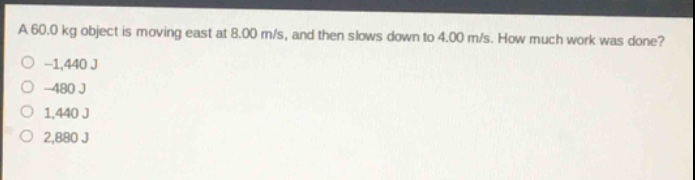
a 60.0 kg object is moving east at 8.00 m/s, and then slows down to 4.00 m/s. how much work was done?\n-1,440 j\n-480 j\n1,440 j\n2,880 j
Answer
Explanation:
Step1: Recall work - energy theorem
The work - energy theorem states that $W=\Delta K = K_f - K_i$, where $W$ is the work done, $K_f$ is the final kinetic energy, and $K_i$ is the initial kinetic energy. The formula for kinetic energy is $K=\frac{1}{2}mv^{2}$, with $m$ being the mass and $v$ the velocity.
Step2: Calculate the initial kinetic energy
Given $m = 60.0\ kg$ and $v_i=8.00\ m/s$, then $K_i=\frac{1}{2}mv_i^{2}=\frac{1}{2}\times60\times(8)^{2}= \frac{1}{2}\times60\times64 = 1920\ J$.
Step3: Calculate the final kinetic energy
Given $m = 60.0\ kg$ and $v_f = 4.00\ m/s$, then $K_f=\frac{1}{2}mv_f^{2}=\frac{1}{2}\times60\times(4)^{2}=\frac{1}{2}\times60\times16=480\ J$.
Step4: Calculate the work done
$W=K_f - K_i=480 - 1920=- 1440\ J$.
Answer:
-1,440 J