the absolute temperature of a gas is increased four times while maintaining a constant volume. what happens…
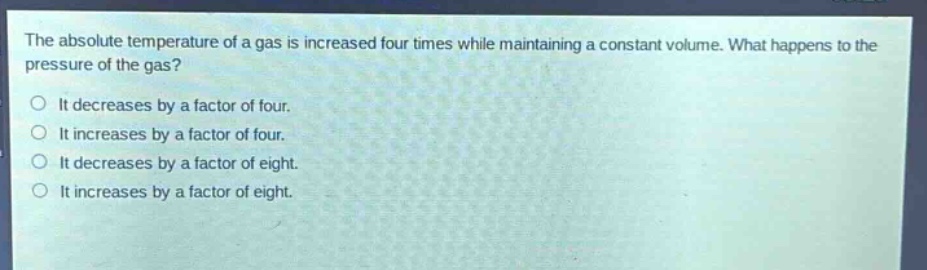
the absolute temperature of a gas is increased four times while maintaining a constant volume. what happens to the pressure of the gas?\nit decreases by a factor of four.\nit increases by a factor of four.\nit decreases by a factor of eight.\nit increases by a factor of eight.
Answer
Explanation:
Step1: Recall the ideal gas law
For a fixed - amount of gas at constant volume, $\frac{P_1}{T_1}=\frac{P_2}{T_2}$ (from $PV = nRT$, when $V$, $n$, and $R$ are constant).
Step2: Let the initial temperature be $T_1$ and the final temperature be $T_2 = 4T_1$
We have $\frac{P_1}{T_1}=\frac{P_2}{T_2}$. Substitute $T_2 = 4T_1$ into the equation: $\frac{P_1}{T_1}=\frac{P_2}{4T_1}$.
Step3: Cross - multiply to solve for $P_2$
Cross - multiplying gives $P_2\times T_1=P_1\times4T_1$. Canceling out $T_1$ (since $T_1\neq0$), we get $P_2 = 4P_1$.
Answer:
It increases by a factor of four.