according to the concept of length contraction, what happens to the length of an object as it approaches the…
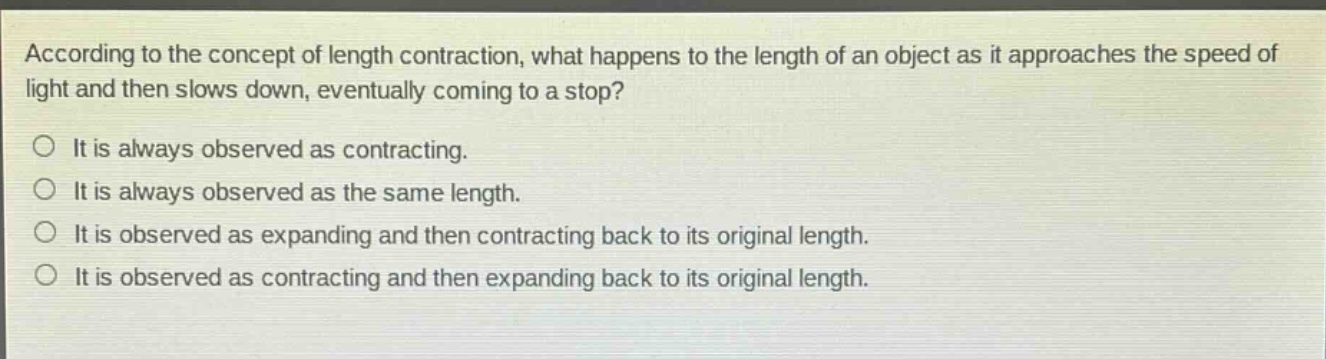
according to the concept of length contraction, what happens to the length of an object as it approaches the speed of light and then slows down, eventually coming to a stop?\no it is always observed as contracting.\no it is always observed as the same length.\no it is observed as expanding and then contracting back to its original length.\no it is observed as contracting and then expanding back to its original length.
Answer
Answer:
It is observed as contracting and then expanding back to its original length.
Explanation:
Step1: Recall length - contraction formula
The length contraction formula is $L = L_0\sqrt{1-\frac{v^2}{c^2}}$, where $L$ is the observed length, $L_0$ is the proper length (length at rest), $v$ is the velocity of the object and $c$ is the speed of light.
Step2: Analyze when approaching light - speed
As $v$ approaches $c$, $\frac{v^2}{c^2}$ approaches 1, and $\sqrt{1 - \frac{v^2}{c^2}}$ approaches 0, so $L$ (observed length) contracts compared to $L_0$.
Step3: Analyze when slowing down
As $v$ decreases from near - $c$ to 0, $\frac{v^2}{c^2}$ decreases from near 1 to 0. Then $\sqrt{1-\frac{v^2}{c^2}}$ increases from near 0 back to 1, and $L$ expands back to $L_0$.