which of these actions would increase heat transfer between two objects?\no establishing their thermal…
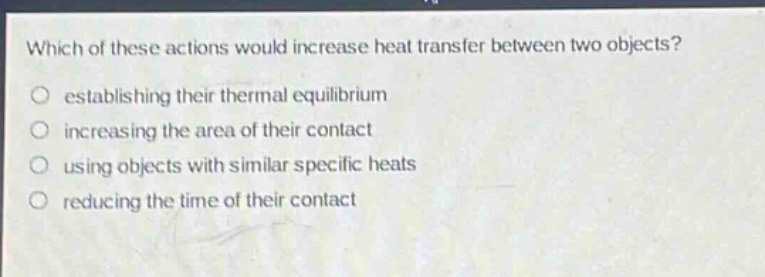
which of these actions would increase heat transfer between two objects?\no establishing their thermal equilibrium\no increasing the area of their contact\no using objects with similar specific heats\no reducing the time of their contact
Answer
Answer:
B. increasing the area of their contact
Explanation:
Step1: Understand heat - transfer factors
Heat transfer is related to factors like temperature difference, contact area, time, and thermal properties.
Step2: Analyze each option
- Establishing thermal equilibrium: When two objects are in thermal equilibrium, there is no net heat transfer, so this does not increase heat transfer.
- Increasing the area of their contact: According to the heat - transfer formula $Q = kA\frac{\Delta T}{d}$ (for conduction, where $Q$ is heat transfer, $k$ is thermal conductivity, $A$ is contact area, $\Delta T$ is temperature difference, and $d$ is thickness), increasing $A$ increases $Q$.
- Using objects with similar specific heats: Specific heat is related to the amount of heat an object can store per unit mass and temperature change, not directly to the rate of heat transfer between two objects.
- Reducing the time of their contact: Reducing contact time decreases the amount of heat transferred according to the basic concept of heat - transfer over time.