alana summarized what happens when a ball sitting on top of a grassy hill rolls down the hill. the…
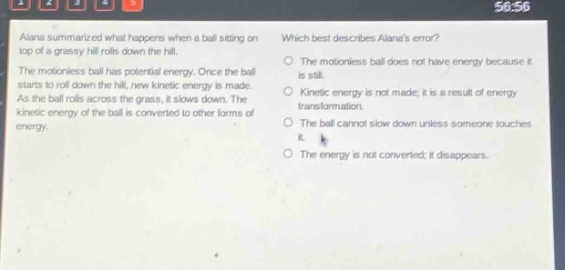
alana summarized what happens when a ball sitting on top of a grassy hill rolls down the hill. the motionless ball has potential energy. once the ball starts to roll down the hill, new kinetic energy is made. as the ball rolls across the grass, it slows down. the kinetic energy of the ball is converted to other forms of energy. which best describes alanas error? the motionless ball does not have energy because it is still. kinetic energy is not made; it is a result of energy transformation. the ball cannot slow down unless someone touches it. the energy is not converted; it disappears.
Answer
Explanation:
Step1: Recall energy - conservation principle
Energy cannot be created or destroyed, only transformed. A motionless ball at the top of a hill has potential energy due to its height. When it rolls down, this potential energy is converted into kinetic energy.
Step2: Analyze each option
- The motionless ball has potential energy, so the statement "The motionless ball does not have energy because it is still" is incorrect.
- Kinetic energy is a result of energy transformation (from potential energy in this case), not created out of nothing. This is correct according to the law of conservation of energy.
- A ball can slow down due to friction (e.g., between the ball and the grass) without being touched, so "The ball cannot slow down unless someone touches it" is wrong.
- Energy is always conserved and not "disappears", so "The energy is not converted; it disappears" is incorrect.
Answer:
Kinetic energy is not made; it is a result of energy transformation.