2. alex has a type of rock called calcite, that sometimes glows. he puts the calcite under a desk lamp but…
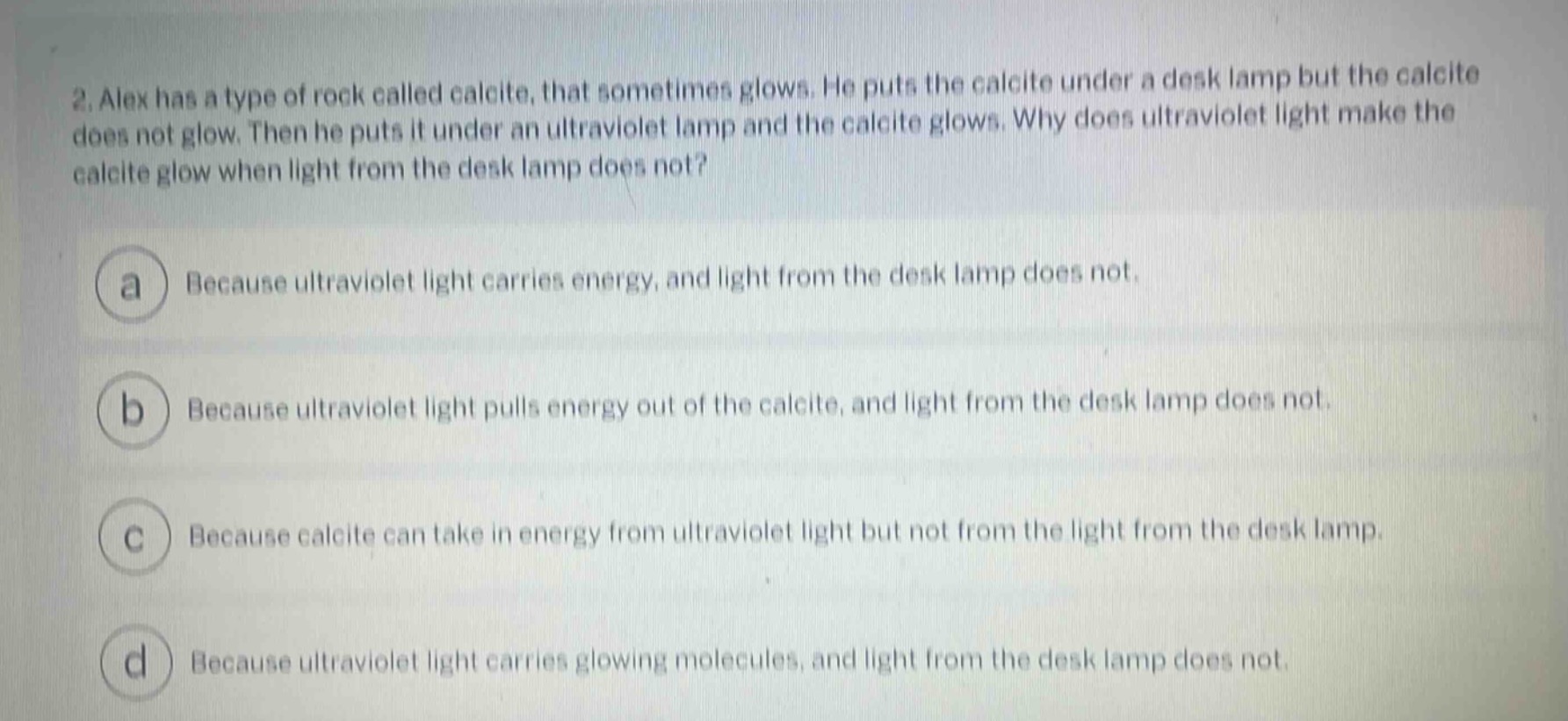
2. alex has a type of rock called calcite, that sometimes glows. he puts the calcite under a desk lamp but the calcite does not glow. then he puts it under an ultraviolet lamp and the calcite glows. why does ultraviolet light make the calcite glow when light from the desk lamp does not?\na because ultraviolet light carries energy, and light from the desk lamp does not.\nb because ultraviolet light pulls energy out of the calcite, and light from the desk lamp does not.\nc because calcite can take in energy from ultraviolet light but not from the light from the desk lamp.\nd because ultraviolet light carries glowing molecules, and light from the desk lamp does not.
Answer
Brief Explanations:
Calcite glows under ultraviolet light due to its ability to absorb the energy from ultraviolet photons. Desk - lamp light does not have the right energy level for calcite to absorb and re - emit as visible light (glow). All light, including from a desk lamp, carries energy, so option a is incorrect. Ultraviolet light does not pull energy out of calcite (option b is wrong), and light is not made of glowing molecules (option d is incorrect).
Answer:
C. Because calcite can take in energy from ultraviolet light but not from the light from the desk lamp.