am and fm are methods of broadcasting radio signals with electromagnetic waves. am stands for amplitude…
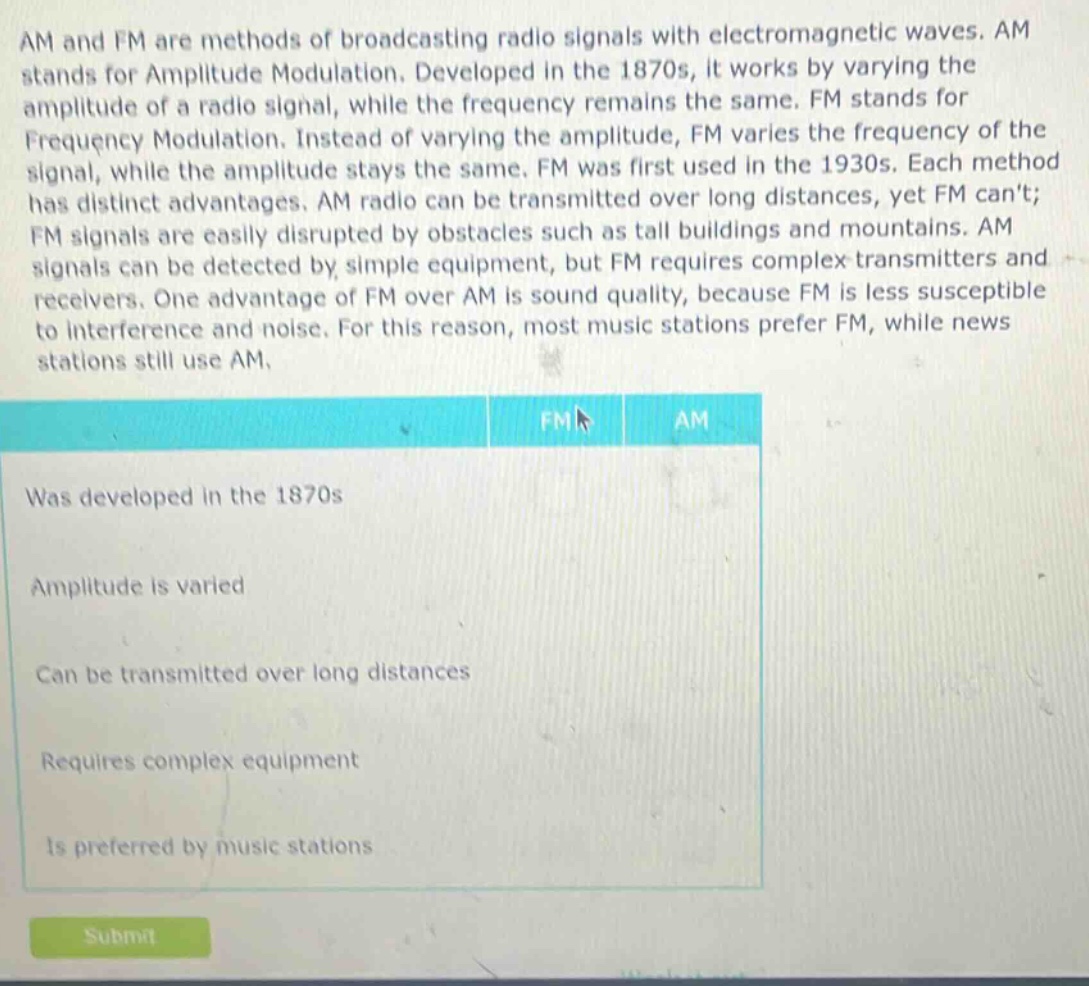
am and fm are methods of broadcasting radio signals with electromagnetic waves. am stands for amplitude modulation. developed in the 1870s, it works by varying the amplitude of a radio signal, while the frequency remains the same. fm stands for frequency modulation. instead of varying the amplitude, fm varies the frequency of the signal, while the amplitude stays the same. fm was first used in the 1930s. each method has distinct advantages. am radio can be transmitted over long distances, yet fm cant; fm signals are easily disrupted by obstacles such as tall buildings and mountains. am signals can be detected by simple equipment, but fm requires complex transmitters and receivers. one advantage of fm over am is sound quality, because fm is less susceptible to interference and noise. for this reason, most music stations prefer fm, while news stations still use am.\nwas developed in the 1870s\namplitude is varied\ncan be transmitted over long distances\nrequires complex equipment\nis preferred by music stations
Answer
Brief Explanations:
AM was developed in the 1870s and varies amplitude, can be transmitted long - distance and detected by simple equipment. FM was first used in the 1930s, varies frequency, requires complex equipment and is preferred by music stations for better sound quality.
Answer:
Was developed in the 1870s: AM Amplitude is varied: AM Can be transmitted over long distances: AM Requires complex equipment: FM Is preferred by music stations: FM