the amount of a radioactive substance remaining after t years is given by the function f(t)=m(0.5)^(t/h)…
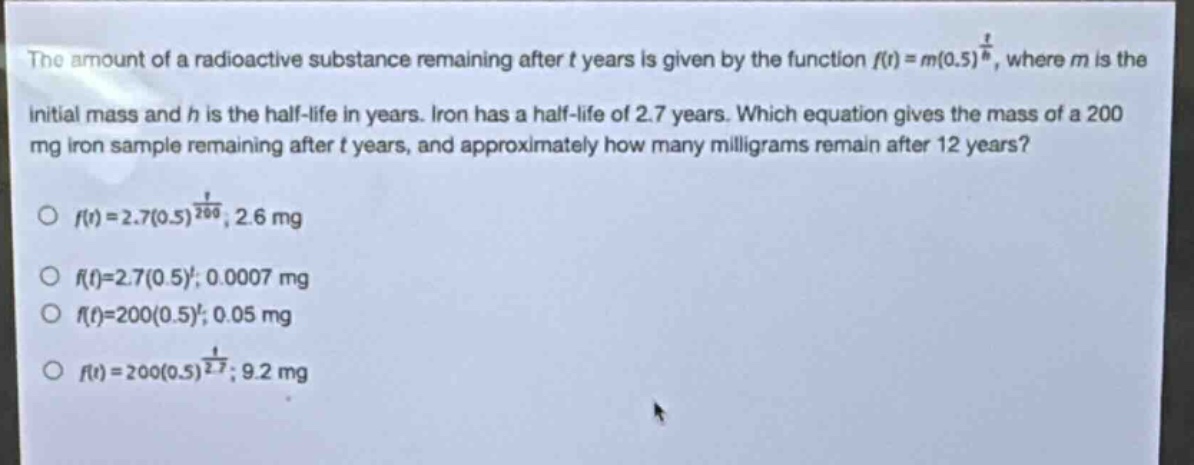
the amount of a radioactive substance remaining after t years is given by the function f(t)=m(0.5)^(t/h), where m is the initial mass and h is the half - life in years. iron has a half - life of 2.7 years. which equation gives the mass of a 200 mg iron sample remaining after t years, and approximately how many milligrams remain after 12 years?\no f(t)=2.7(0.5)^(t/200); 2.6 mg\no f(t)=2.7(0.5)^t; 0.0007 mg\no f(t)=200(0.5)^t; 0.05 mg\no f(t)=200(0.5)^(t/2.7); 9.2 mg
Answer
Explanation:
Step1: Identify values for formula
Given $m = 200$ (initial mass), $h=2.7$ (half - life). Substitute into $f(t)=m(0.5)^{\frac{t}{h}}$, we get $f(t)=200(0.5)^{\frac{t}{2.7}}$.
Step2: Calculate mass after 12 years
Substitute $t = 12$ into $f(t)=200(0.5)^{\frac{t}{2.7}}$. So $f(12)=200\times(0.5)^{\frac{12}{2.7}}$. First, calculate $\frac{12}{2.7}\approx4.44$. Then $(0.5)^{4.44}\approx0.046$. And $200\times0.046 = 9.2$ mg.
Answer:
D. $f(t)=200(0.5)^{\frac{t}{2.7}};9.2$ mg