the amount of a sample remaining after t days is given by the equation $p(t)=a(\frac{1}{2})^{\frac{t}{h}}$…
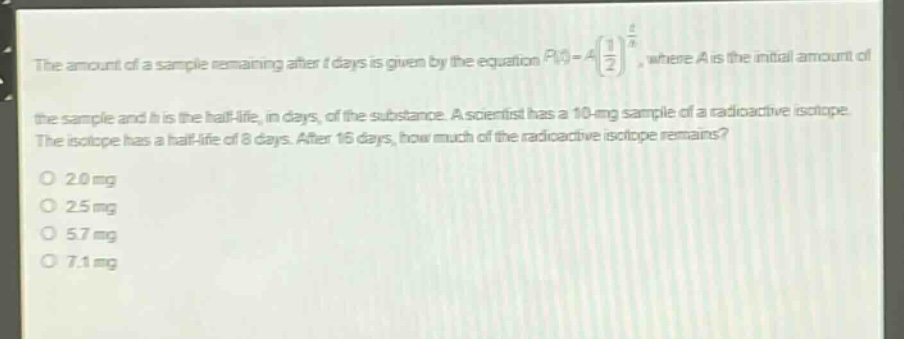
the amount of a sample remaining after t days is given by the equation $p(t)=a(\frac{1}{2})^{\frac{t}{h}}$, where a is the initial amount of the sample and h is the half - life, in days, of the substance. a scientist has a 10 - mg sample of a radioactive isotope. the isotope has a half - life of 8 days. after 16 days, how much of the radioactive isotope remains?\no 2.0 mg\no 2.5 mg\no 5.7 mg\no 7.1 mg
Answer
Explanation:
Step1: Identify given values
$A = 10$ mg, $h=8$ days, $t = 16$ days
Step2: Substitute values into formula
$P(t)=A\left(\frac{1}{2}\right)^{\frac{t}{h}}$, so $P(16)=10\times\left(\frac{1}{2}\right)^{\frac{16}{8}}$
Step3: Simplify exponent
$\frac{16}{8}=2$, so $P(16)=10\times\left(\frac{1}{2}\right)^{2}$
Step4: Calculate power
$\left(\frac{1}{2}\right)^{2}=\frac{1}{4}$, so $P(16)=10\times\frac{1}{4}$
Step5: Calculate final amount
$10\times\frac{1}{4} = 2.5$ mg
Answer:
2.5 mg