the amount of a sample remaining after t days is given by the equation p(t)=a(1/2)^(t/h), where a is the…
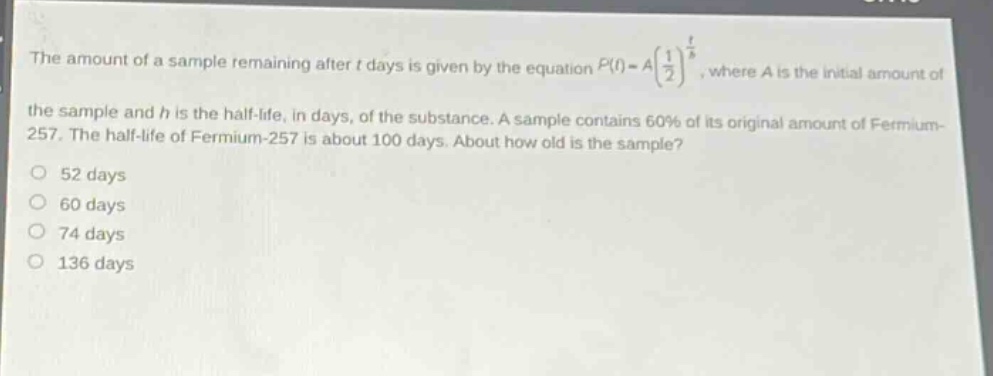
the amount of a sample remaining after t days is given by the equation p(t)=a(1/2)^(t/h), where a is the initial amount of the sample and h is the half - life, in days, of the substance. a sample contains 60% of its original amount of fermium - 257. the half - life of fermium - 257 is about 100 days. about how old is the sample? 52 days 60 days 74 days 136 days
Answer
Explanation:
Step1: Set up the equation
We know that $P(t)=0.6A$ (since the sample contains 60% of the original amount), $h = 100$. Substitute into $P(t)=A(\frac{1}{2})^{\frac{t}{h}}$ to get $0.6A=A(\frac{1}{2})^{\frac{t}{100}}$. Divide both sides by $A$ (since $A\neq0$), we have $0.6 = (\frac{1}{2})^{\frac{t}{100}}$.
Step2: Take the natural - logarithm of both sides
$\ln(0.6)=\ln((\frac{1}{2})^{\frac{t}{100}})$. Using the property of logarithms $\ln(a^b)=b\ln(a)$, we get $\ln(0.6)=\frac{t}{100}\ln(\frac{1}{2})$.
Step3: Solve for $t$
$t = 100\times\frac{\ln(0.6)}{\ln(\frac{1}{2})}$. We know that $\ln(0.6)\approx - 0.5108$ and $\ln(\frac{1}{2})\approx-0.6931$. Then $t = 100\times\frac{- 0.5108}{-0.6931}\approx74$.
Answer:
74 days