analyze the circuit to determine the unknown currents. how many complete routes exist in the circuit? 3
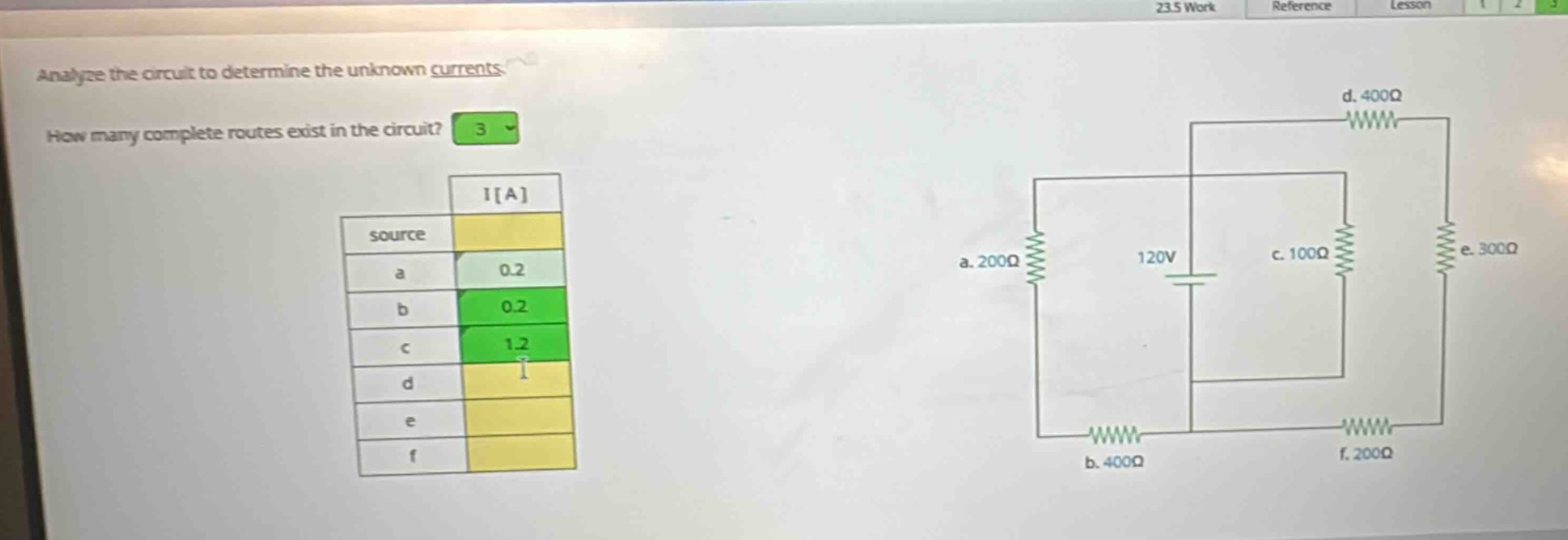
analyze the circuit to determine the unknown currents. how many complete routes exist in the circuit? 3
Answer
Explanation:
Step1: Apply Kirchhoff's laws
We can use Kirchhoff's current law (KCL) at junctions and Kirchhoff's voltage law (KVL) around loops.
Step2: Consider KCL at a junction
Let's consider a junction where currents meet. The sum of currents entering a junction is equal to the sum of currents leaving the junction.
Step3: Consider KVL around loops
For each of the 3 loops in the circuit, the sum of the voltage - drops across the resistors and the voltage sources in a closed - loop is zero. Let's assume the voltage source is (V = 120V). For resistor (a) with (R_a=200\Omega) and (I_a = 0.2A), the voltage drop (V_a=I_aR_a=0.2\times200 = 40V). For resistor (b) with (R_b = 400\Omega) and (I_b=0.2A), the voltage drop (V_b=I_bR_b=0.2\times400 = 80V). For resistor (c) with (R_c = 100\Omega) and (I_c = 1.2A), the voltage drop (V_c=I_cR_c=1.2\times100 = 120V). Using KCL at a junction where (I_c) splits into currents through (d) and (e) and other branches. Also, using KVL around the loops containing (d) and (e). Let's assume the current through (d) is (I_d) and through (e) is (I_e). We know that for a parallel - series combination, we can first find the equivalent resistance of parts of the circuit. The voltage across the parallel part of the circuit (containing (c), (d), (e) etc.) is (120V) (the source voltage). The equivalent resistance of the part of the circuit relevant to finding (I_d): Let's consider the loop analysis. The voltage across the branch with (d) and (e) in series (in relation to the parallel combination) is (120V). The resistance of the path with (d) and (e) is (R_{de}=400 + 300=700\Omega). Since the voltage across this path is (120V), using Ohm's law (I=\frac{V}{R}), and considering the current division rule for parallel - series circuits. The current through (d): We know that the voltage across the branch containing (d) and (e) is (120V). Using Ohm's law (I_d=\frac{V}{R_d + R_e}\times\frac{R_e}{R_d+R_e}) (from current - division rule in a series - parallel circuit). First, find the equivalent resistance of the part of the circuit where (d) and (e) are located. The voltage across this part is (120V). Using Ohm's law (I_d=\frac{120}{400 + 300}\times1=\frac{120}{700}\approx0.171A)
Answer:
(I_d\approx0.171A)